

9 Benefits of Coconut Oil Worth Knowing
Coconut oil gets called everything from a fat-burning miracle to a heart attack waiting to happen. The truth sits in the middle: it has some legitimate uses, but it’s not essential for health.
Here are 9 benefits, what the research supports, and when you should skip it.
Key Takeaways
- MCTs in coconut oil may support energy and metabolism, though effects are modest.
- Most benefits are small, and the saturated fat content matters for heart health.
- Unrefined virgin coconut oil retains more antioxidants than refined versions.
- Coconut oil works as a tool within a balanced approach, not a standalone solution.
- Always patch test first: it can irritate sensitive skin or scalp.
Related Reading
Best coconut oil for skin on Amazon
See our top picks for coconut oil formulated specifically for skincare use.
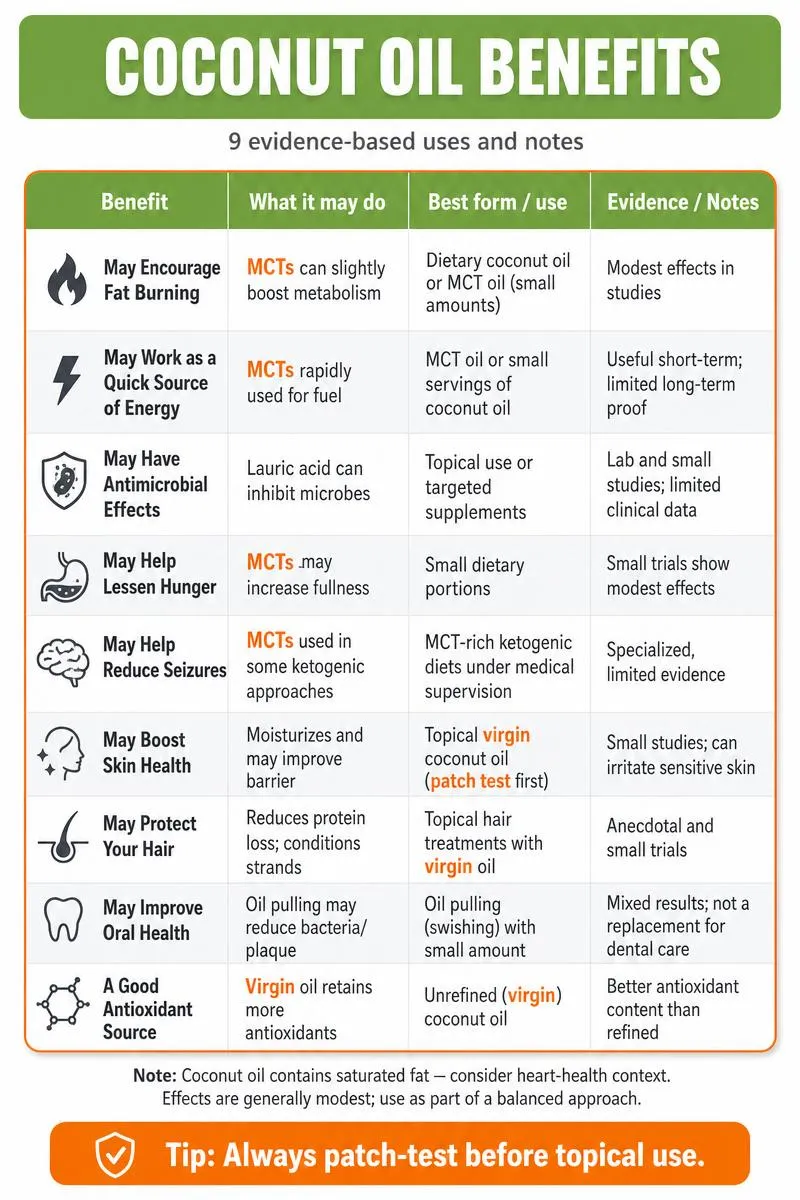
Benefits Of Coconut Oil Quick Comparison
| Benefit | What it may do | Best form / use | Evidence / Notes |
|---|---|---|---|
| May Encourage Fat Burning | MCTs can slightly boost metabolism | Dietary coconut oil or MCT oil (small amounts) | Modest effects in studies |
| May Work as a Quick Source of Energy | MCTs rapidly used for fuel | MCT oil or small servings of coconut oil | Useful short-term; limited long-term proof |
| May Have Antimicrobial Effects | Lauric acid can inhibit microbes | Topical use or targeted supplements | Lab and small studies; limited clinical data |
| May Help Lessen Hunger | MCTs may increase fullness | Small dietary portions | Small trials show modest effects |
| May Help Reduce Seizures | MCTs used in some ketogenic approaches | MCT-rich ketogenic diets under medical supervision | Specialized, limited evidence |
| May Boost Skin Health | Moisturizes and may improve barrier | Topical virgin coconut oil (patch test first) | Small studies; can irritate sensitive skin |
| May Protect Your Hair | Reduces protein loss; conditions strands | Topical hair treatments with virgin oil | Anecdotal and small trials |
| May Improve Oral Health | Oil pulling may reduce bacteria/plaque | Oil pulling (swishing) with small amount | Mixed results; not a replacement for dental care |
| A Good Antioxidant Source | Virgin oil retains more antioxidants | Unrefined (virgin) coconut oil | Better antioxidant content than refined |
What Is Coconut Oil?
Coconut oil comes from pressing the white kernel of mature coconuts. You have two main types to choose from:
- Virgin (unrefined) oil is extracted without chemicals or high heat, so it keeps its natural antioxidants. It smells like coconut.
- Refined oil is processed to remove flavor and odor, so it tastes neutral in cooking but loses some beneficial compounds.
Coconut oil is 80-90% saturated fat. The key difference from butter or beef fat? Much of it comes as medium-chain triglycerides (MCTs), which your body burns more quickly than long-chain fats.
Related Reading
Refined vs unrefined coconut oil
A breakdown of how processing affects flavor, smoke point, and nutrient content.
9 Benefits of Coconut Oil
Some of these have solid research behind them. Others are early-stage or modest at best.
1. May Encourage Fat Burning
MCTs appear to increase calorie burn compared to other fats. Your body breaks them down faster and may use them for energy instead of storing them.
The catch: the effect is modest. Swapping other oils for coconut oil won’t replace eating fewer calories or moving more. For people already watching their weight, it adds a small edge.
2. May Work as a Quick Source of Energy
MCTs convert to ketones rapidly once they reach your liver. This gives you an alternative fuel source that doesn’t rely on glucose.
Some athletes use coconut oil before training for steady energy. People on ketogenic diets rely on it to stay in ketosis. It’s not magic, but it’s a practical fuel for specific situations.
3. May Have Antimicrobial Effects
Lauric acid makes up about half of coconut oil’s fat content. When digested, it forms monolaurin, which some research suggests may help fight certain bacteria, viruses, and fungi.
Early studies on immune support look promising, but the research is ongoing. Don’t count on coconut oil to prevent infections.
4. May Help Lessen Hunger
Ketones may reduce appetite signals in the brain. Some people find a tablespoon of coconut oil in coffee or tea helps them extend a fast or eat less at their next meal.
Individual response varies significantly. Some people feel nothing. Others feel sustained fullness that’s useful for intermittent fasting schedules.
5. May Help Reduce Seizures
This is the most established medical use. Ketogenic diets often include MCT oil from coconut sources. They show documented promise for epilepsy management, particularly in children who don’t respond to medication.
This requires medical supervision. Do not attempt therapeutic ketogenic diets without a doctor’s guidance.
6. May Boost Skin Health
Coconut oil works as an occlusive moisturizer, meaning it sits on top of skin and traps water underneath. It’s particularly effective for dry elbows, knees, and heels.
Some people use it for minor skin irritation or as a barrier against moisture loss. Do a patch test first, because it can clog pores and irritate sensitive or acne-prone skin.
7. May Protect Your Hair
A study from a research institute in India found coconut oil can reduce protein loss in hair, particularly when applied before washing. The lauric acid structure lets it penetrate the hair shaft better than mineral oils.
Use it as a pre-wash treatment or leave-in conditioner for dry ends. Skip it if you have fine hair that gets weighed down easily.
8. May Improve Oral Health
Oil pulling means swishing coconut oil in your mouth for 10-20 minutes. Some research suggests it may reduce harmful oral bacteria and plaque.
It’s been used for centuries in Ayurvedic practice. Treat it as a supplement to brushing and flossing, not a replacement.
9. A Good Antioxidant Source
Virgin coconut oil contains polyphenols, which act as antioxidants in your body. These compounds may help combat oxidative stress from normal metabolism and environmental exposure.
Refined coconut oil has been stripped of most polyphenols. If you want this benefit specifically, choose virgin, unrefined.
How to Use It
Start small. One tablespoon daily is plenty for most people. Your body needs time to adjust to MCTs; too much too fast can cause stomach upset.
- Cook with it at medium heat. Virgin coconut oil’s smoke point (around 350°F) rules out high-heat frying, so choose refined when you want no coconut flavor in savory dishes.
- After a shower, apply to damp skin to lock in moisture.
- For oil pulling, swish for 10-20 minutes, then spit into the trash, since the oil can clog sink pipes.
Related Reading
Benefits of coconut oil for hair
How coconut oil supports hair health, from frizz control to scalp benefits.
Who Should Be Cautious
Some people should think twice before adding coconut oil to their routine:
- If you have cardiovascular risk factors, the saturated fat content (more than butter) may raise LDL cholesterol. Talk to your doctor about existing heart conditions first.
- Coconut allergies are obvious but worth stating: reactions can be severe, from mild rash to anaphylaxis.
- Anyone on a medically prescribed low-fat diet should get clearance first, since some conditions require strict fat restriction.
FAQs
Is a spoonful of coconut oil a day good for you?
For most people, yes. One tablespoon daily is a common starting point. The exceptions are people with cardiovascular disease risk or medically prescribed diets.
Start slowly either way. MCTs can cause loose stools if your body isn’t used to them.
Is coconut oil healthier than olive oil?
Depends on your goals. Olive oil has decades of heart-health research behind it. Coconut oil handles medium heat better and provides quick energy.
For everyday cooking, olive oil wins for most people. Reach for coconut oil when you want its specific properties: MCTs, heat stability, mild flavor.
Which is better, coconut or palm oil?
Coconut oil. Palm oil has similar saturated fat levels but none of the MCTs.
Coconut production also tends to carry less environmental baggage than industrial palm harvesting, though this varies by source.
What happens if we apply coconut oil daily on the body?
For some, it hydrates and softens skin. Others break out or develop irritation.
Coconut oil is comedogenic, meaning it can clog pores. If you have body acne or sensitive skin, use it sparingly or patch test one area first.
Should I take coconut oil in the morning or at night?
Morning is more common, usually stirred into coffee or breakfast for sustained energy. Night use makes sense if you’re applying it to skin or hair.
There isn’t strong evidence that timing changes the benefits.
Is there a downside to coconut oil?
Yes. It’s high in saturated fat, which may affect cholesterol levels. It’s also calorie-dense, so adding it without adjusting your other intake can lead to weight gain.
It can also irritate skin and scalp, and some people find it simply doesn’t agree with their digestion.
Related Reading
Benefits of coconut oil pulling
What oil pulling actually does, and what the evidence says about oral health claims.
Final Thoughts
Coconut oil isn’t a miracle food or a health hazard. It’s a useful tool with specific applications: quick energy, skin moisture, hair protection, and ketogenic support. The benefits are modest, the saturated fat is real, and it isn’t essential for health.
If you’re curious, grab a jar of virgin, unrefined coconut oil and try one application. Cook with it, stir a spoonful into your morning coffee, or rub a small amount into dry skin and hair ends.
See what it does for you specifically. That’s the only way to know if it earns its spot in your routine.
External References