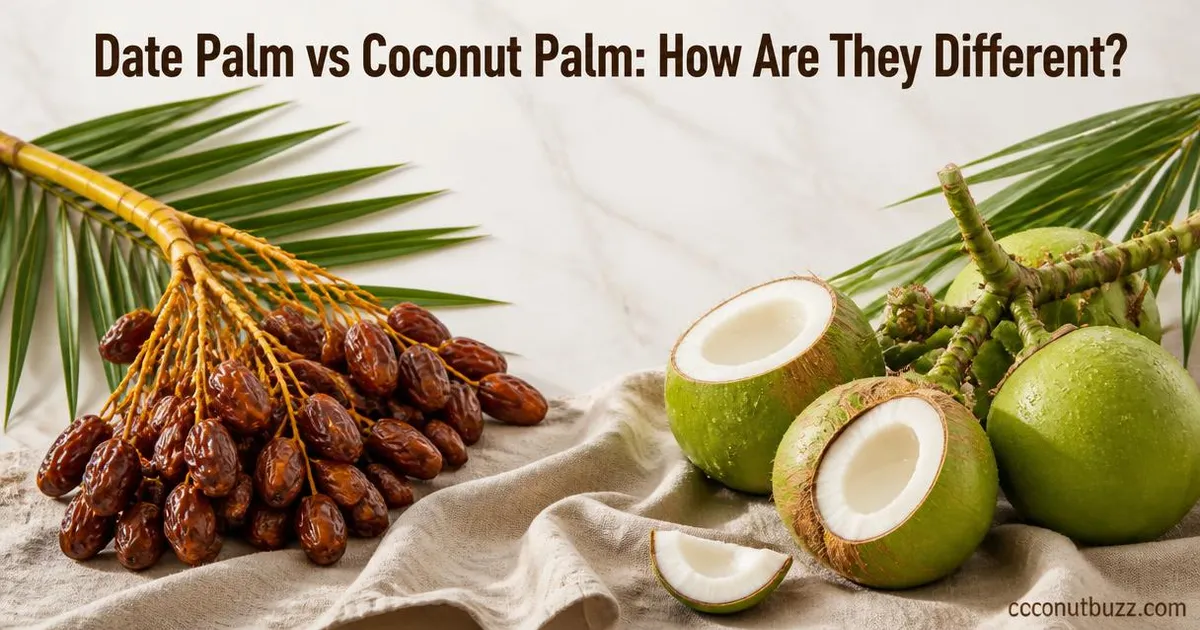
Date Palm vs Coconut Palm: How Are They Different?
If you’re staring at a tall palm wondering which species it is, or planning to plant one and need to know which fits your yard, the answer comes down to three things: what the trunk and leaves look like, whether your climate is dry or humid, and what you want to harvest. Date palms and coconut palms look different up close, grow in opposite climates, and produce completely different products.
Key Takeaways
- Both trees belong to the palm family, yet only coconut palms bear coconuts
- The two species differ clearly in trunk shape, leaf structure, and mature height
- Date palms thrive in hot, arid regions with low rainfall; coconut palms need tropical humidity and coastal conditions
- Dates are consumed as whole fruit; coconuts yield water, oil, milk, and fiber for varied uses
- Choose date palms for dry landscapes; choose coconut palms for humid tropical environments
Worth Reading Next
Coconut water vs sports drinks
A practical comparison of coconut water and sports drinks that helps readers weigh hydration uses tied to choosing a…
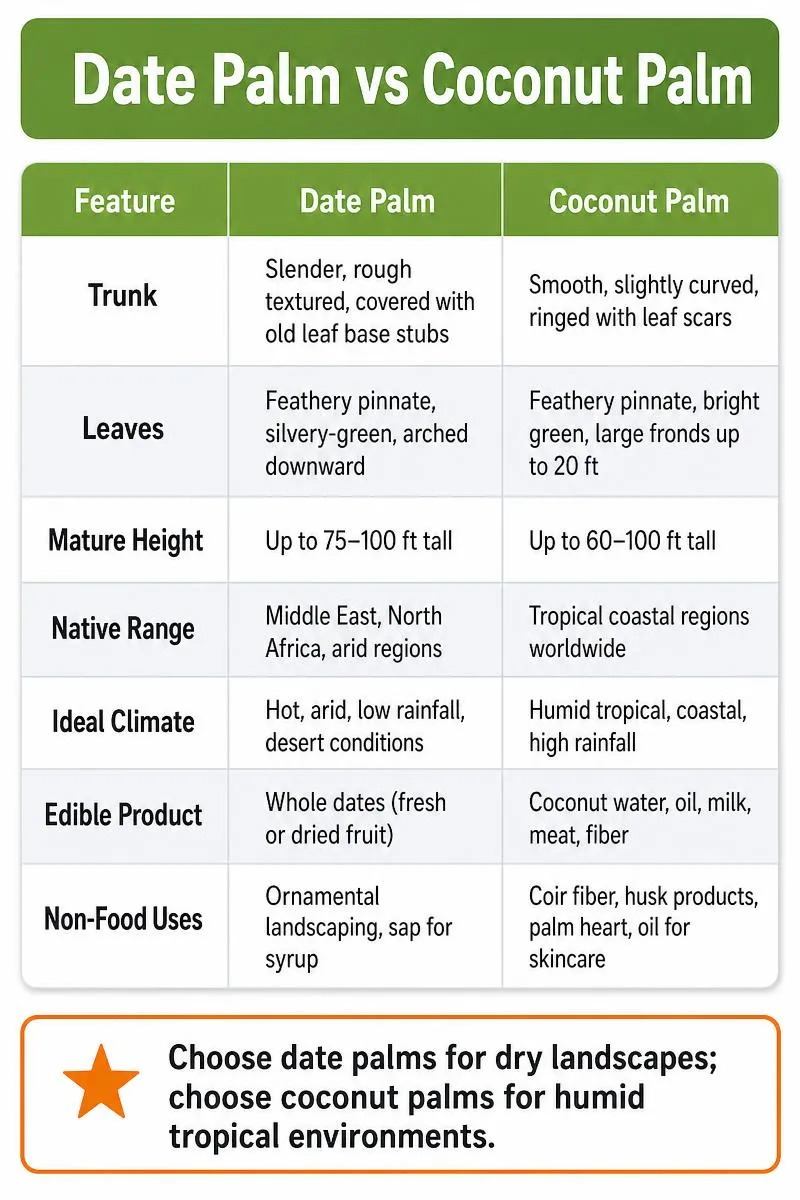
Date Palm Vs Coconut Palm Side-by-Side
| Feature | Date Palm | Coconut Palm |
|---|---|---|
| Trunk | Slender, rough, covered with old leaf base stubs | Smooth, slightly curved, ringed with leaf scars |
| Leaves | Feathery pinnate, silvery‑green, arched downward | Feathery pinnate, bright green, large fronds (up to 20 ft) |
| Mature Height | Up to 75–100 ft | Up to 60–100 ft |
| Native Range | Middle East, North Africa, arid regions | Tropical coastal regions worldwide |
| Ideal Climate | Hot, arid, low rainfall | Humid tropical, coastal, high rainfall |
| Edible Product | Whole dates (fresh or dried) | Coconut water, oil, milk, meat, fiber |
| Non‑Food Uses | Ornamental landscaping, sap for syrup | Coir fiber, husk products, palm heart, oil for skincare |
What Is a Date Palm?
Phoenix dactylifera is cultivated for its sweet edible fruit and adapted to some of the driest climates where palms can grow. Commercial date farms and backyard fruit harvest in hot, arid regions are the most common uses.
The tree tolerates drought better than most palms, lives for decades while producing fruit, and meets established culinary demand for dates as a natural sweetener. Date palms need specific arid climate conditions to produce well and take several years to reach peak production, which limits where they work as a practical planting choice.
What Is a Coconut Palm?
Cocos nucifera is cultivated for its versatile fruit and the range of products that come from it. Tropical coastal landscaping and coconut product harvest are the primary use cases.
A single coconut palm produces more usable products than most palms offer – water, oil, milk, meat, and fiber from one tree. Coconut palms require constant tropical warmth and humidity, making them sensitive to cold and unsuitable for regions with seasonal temperature drops. The trees also need well-drained soil and struggle in heavy clay or compacted ground.
Date Palm vs Coconut Palm: Physical Characteristics
Trunk shape and surface texture are the fastest way to tell these palms apart from a distance.
1. Trunk Shape and Surface Texture
Date palms have thick, columnar trunks covered in a rough, diamond-patterned texture left by old leaf bases. The trunk stays relatively straight and appears thick at maturity.
Coconut palms have smoother trunks with visible ring scars where fronds have fallen off. The trunk often leans or curves, especially in coastal areas, and appears slender compared to date palms.
2. Leaf Structure and Arrangement
Date palm fronds are stiff, blue-green to gray-green, and arranged in a dense crown. Each frond has sharp, pointed leaflets that grow from a central midrib, and the lowest leaflets are often modified into spines.
Coconut palm fronds are longer, more arching, and bright green. The leaflets are softer and droop more noticeably, giving the crown a feathery appearance without the rigid structure of date palm leaves.
3. Mature Height and Growth Habit
Date palms typically reach tall heights at maturity, though many stay shorter in less-than-ideal conditions. The crown remains compact and symmetrical.
Coconut palms can grow very tall in optimal tropical conditions. The crown is looser, with fewer fronds that spread wider than those of a date palm.
4. Identification Tips
If the trunk is thick, textured, and straight with a tight crown of stiff blue-green leaves, you’re looking at a date palm. If the trunk is smooth, curved, and slender with long arching fronds, it’s a coconut palm.
Fruit is the clearest identifier – dates grow in large hanging clusters near the crown, while coconuts grow singly or in small groups directly below the fronds.
Worth Reading Next
A focused look at how coconut palms differ from other palm species, including classification and growth traits relevant…
Date Palm vs Coconut Palm: Native Range and Ideal Climate
Date palms are native to the Middle East and North Africa, where hot, arid conditions and minimal rainfall define the growing season. Phoenix dactylifera evolved in desert oases and irrigated valleys, thriving where daytime temperatures soar and rainfall is minimal.
Coconut palms are native to tropical coastal zones across the Indo-Pacific region. Cocos nucifera grows best where humidity stays high year-round, temperatures stay warm, and rainfall is abundant.
Climate Requirements Compared
Date palms tolerate extreme heat and can survive brief cold snaps, though prolonged freezes damage fruit production. The trees prefer sandy, well-drained soil and actually produce sweeter fruit in low-humidity environments. Excess rainfall during fruiting season can split the dates or encourage fungal issues.
Coconut palms need constant warmth, with temperatures ideally staying consistently warm. The trees can’t tolerate frost and show stress in cool temperatures. High humidity, regular rainfall, and coastal breezes create the conditions where coconut palms grow fastest and produce the most fruit.
US Growing Regions
Date palms grow successfully in parts of California, Arizona, and southern Nevada – areas with hot, dry summers and mild winters. Southern California produces most US-grown dates.
Coconut palms grow in southern Florida, Hawaii, and the southernmost tip of Texas where winter temperatures rarely threaten freezing. Hawaii’s consistent tropical climate supports the healthiest coconut palms in the US.
Date Palm vs Coconut Palm: Uses and Edible Products
Dates are eaten whole, either fresh or dried, and function as a natural sweetener in baking, smoothies, and energy bars. The fruit contains fructose and glucose, along with small amounts of potassium and fiber.
Fresh dates have a soft, caramel-like texture; dried dates concentrate the sugars and store for months without refrigeration. Coconut palms produce water, milk, oil, meat, and fiber from a single fruit.
Coconut water comes from the liquid inside young green coconuts and contains electrolytes including potassium and sodium. Coconut milk is made by blending the white meat with water, creating a base for curries and soups. Coconut oil is extracted from dried coconut meat and contains medium-chain triglycerides, primarily lauric acid. The fibrous husk provides coir for rope, mats, and potting medium.
Non-Food Utility
Date palms serve as tall ornamental focal trees in arid landscaping, casting shade and creating a vertical anchor in dry landscapes. The fronds are sometimes woven into baskets, though this is less common than it once was.
Coconut palms provide thatch for roofing in tropical regions, with the dried fronds lasting several years when properly installed. The trunks are used in construction for posts and beams where termite-resistant, lightweight wood is needed. As ornamental trees, coconut palms are the signature tree of tropical coastlines.
Which Wins for Edible Yield
Neither wins universally – the answer depends on your climate and what you want to harvest. Date palms produce a single product with strong culinary demand in regions where almost nothing else fruits reliably. Coconut palms produce multiple products from one tree, making them more versatile in suitable climates.
Which Should You Choose?
If you have a hot, dry backyard with low rainfall and want a fruit tree that tolerates desert conditions, plant a date palm. The tree will handle extreme summer heat and produce fruit where coconut palms would immediately fail.
If you live in a humid tropical climate and want multiple harvestable products from one tree, choose a coconut palm. You’ll get water, oil, milk, and fiber instead of a single fruit type.
For a tall ornamental focal tree in arid landscaping, date palms work better. The thick trunk and dense crown create a strong visual anchor in desert gardens, and the tree won’t demand the constant moisture that coconut palms need.
If you’re identifying a coastal palm in Florida or Hawaii, you’re likely looking at a coconut palm. Date palms grow poorly in high humidity and rarely appear in true coastal environments.
In regions with occasional winter frost, neither palm is ideal, though date palms tolerate cold better. A brief hard freeze will damage a coconut palm severely but might only reduce fruit quality on a mature date palm.
Related Reading
A close comparison of coconut water and Pedialyte that readers choosing a coconut palm for its edible harvest may find…
FAQs About Date Palms and Coconut Palms
Why don’t all palm trees have coconuts?
Only Cocos nucifera produces coconuts. The palm family includes thousands of species, and most produce small, inedible fruits or no fruit at all.
Date palms produce dates, while many ornamental palms like the queen palm produce small berries that birds eat but humans don’t.
How can I tell if I have a date palm tree?
Check for a thick, textured trunk with a diamond pattern and stiff, blue-green fronds with spiny leaflets near the base. If you see large hanging clusters of oval fruit near the crown, it’s a date palm. The fruit turns from green to amber or brown as it ripens.
Are date palms and coconut palms in the same family?
Yes, both belong to Arecaceae, the palm family. Phoenix dactylifera and Cocos nucifera are different genera, which is why they look and grow so differently despite being related.
Which US states grow coconut palms?
Hawaii, southern Florida, and the southern tip of Texas. Hawaii has the most consistent tropical climate for coconut palms, while southern Florida supports them in frost-free coastal zones. Anywhere with regular winter freezes won’t support coconut palms long-term.
How long does it take for a coconut palm to reach full height?
Coconut palms grow at varying rates depending on conditions, but most take several decades to reach full height in ideal tropical climates. Young palms may add height at a moderate rate in optimal conditions, slowing as they age.
Is it illegal to pick up coconuts in Florida?
It depends on where the coconut falls. Picking coconuts from private property without permission is trespassing. Coconuts on public beaches or parks may be regulated by local ordinances, and some areas prohibit taking any plant material. Check local rules before collecting.
Can I take a coconut home from Florida?
You can take a coconut home if you legally obtained it, but consider agricultural restrictions if you’re crossing state lines. Some states regulate the movement of fresh coconuts to prevent pest introduction. Dried, store-bought coconuts travel without issue.
Which US state has the most coconut palms?
Hawaii. The entire state sits in a tropical climate zone ideal for coconut palms, while Florida’s coconut-growing regions are limited to the southernmost frost-free areas. Hawaii’s consistent warmth and humidity support healthier, more productive coconut palms statewide.
Final Thoughts
Date palms and coconut palms serve entirely different climates and purposes, so the right choice depends on your location and what you want from the tree. In dry subtropical zones, date palms are the practical option; in humid tropical coastlines, coconut palms are the natural fit.
Verify your local growing zone, then inspect trunk shape and leaf structure to confirm which palm you have or which one will actually thrive in your yard.
External References