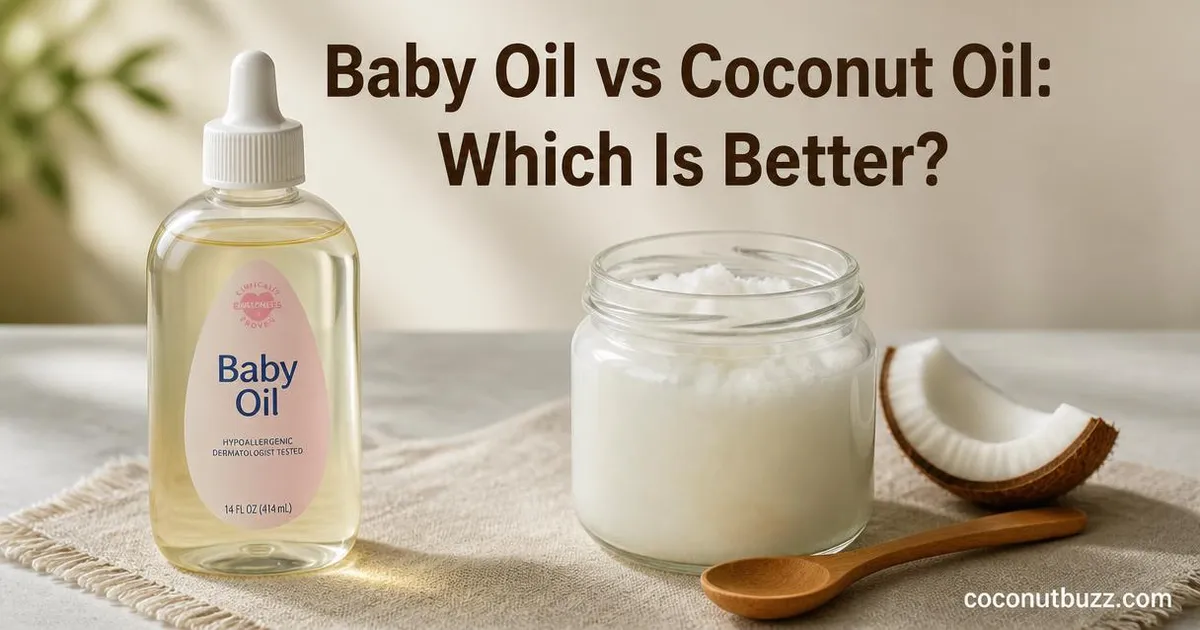
Baby Oil vs Coconut Oil: Which Is Better?
Baby oil and coconut oil sit at opposite ends of the skin care spectrum. One is a petroleum byproduct designed to seal moisture in. The other is a plant extract that absorbs into skin.
Both show up in baby massage guides and hair care routines, but they work differently enough that choosing between them matters. Baby oil forms a protective layer on top of skin, while coconut oil delivers medium-chain fatty acids that penetrate more readily. Which one works better depends entirely on what you’re trying to do.
Key Takeaways
- Baby oil creates a surface barrier that locks in moisture; coconut oil absorbs into skin instead of sitting on top
- Coconut oil appears more frequently in natural and traditional massage routines, while baby oil is common in hospital-affiliated guidance
- Hair type and styling goal determine which oil performs better – baby oil adds shine, coconut oil conditions
- Unrefined coconut oil is a single ingredient; baby oil typically contains mineral oil plus added fragrance
- Babies with central lines, broken skin, or fragrance sensitivities require medical clearance before using either product
Comparing the Top Baby Oil Vs Coconut Oil
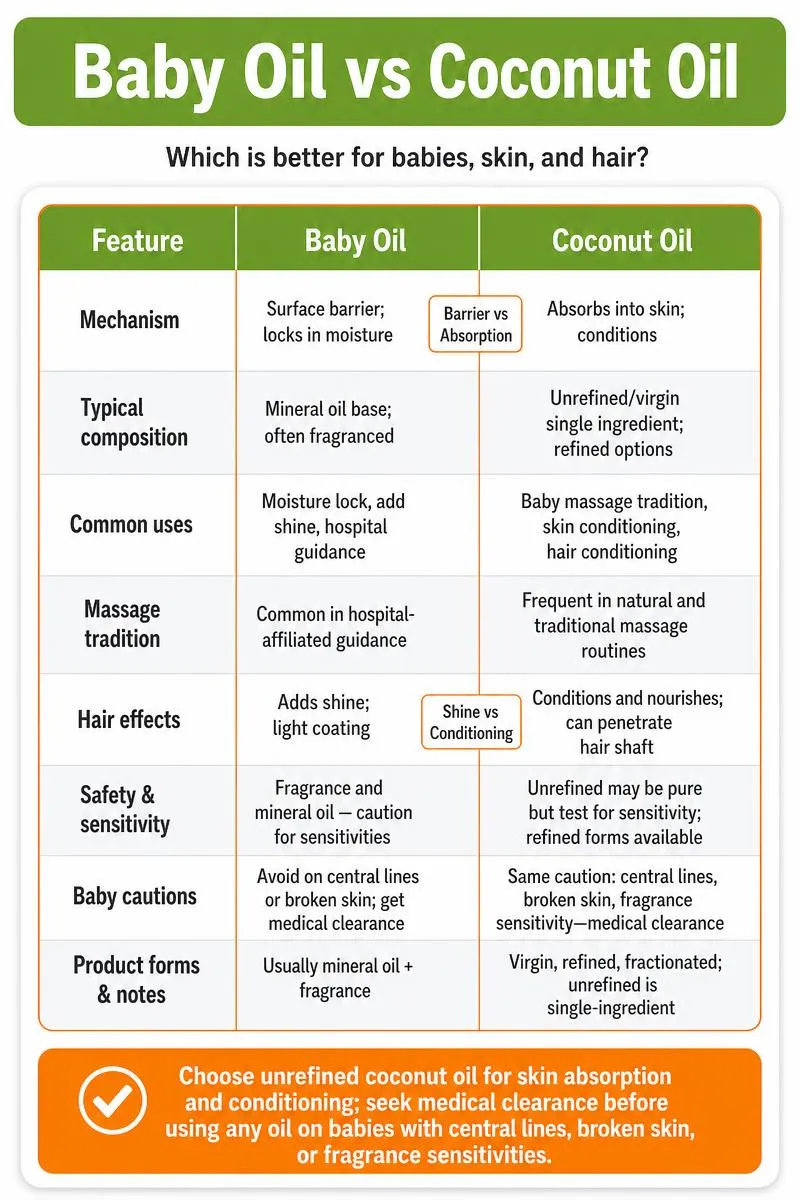
| Feature | Baby Oil | Coconut Oil |
|---|---|---|
| Mechanism | Surface barrier; locks in moisture | Absorbs into skin; conditions |
| Typical composition | Mineral oil base, often fragranced | Unrefined/virgin single ingredient; refined options |
| Common uses | Moisture lock, add shine, hospital guidance | Baby massage, skin conditioning, hair conditioning |
| Massage tradition | Common in hospital-affiliated guidance | Frequent in natural and traditional routines |
| Hair effects | Adds shine; light coating | Conditions and nourishes; can penetrate shaft |
| Safety & sensitivity | Fragrance and mineral oil — caution for sensitivities | Unrefined may be pure; test for sensitivity |
| Baby cautions | Avoid on central lines or broken skin; get medical clearance | Same caution: central lines, broken skin, fragrance sensitivity |
| Product forms & notes | Usually mineral oil plus fragrance | Virgin, refined, fractionated; unrefined is single-ingredient |
What Is Baby Oil?
Baby oil is mineral oil – a petroleum byproduct – formulated with fragrance for infant skin care. The mineral oil base is refined to remove impurities, then a synthetic scent is added.
The oil sits on top of skin rather than absorbing, creating a barrier that prevents water loss. This makes it effective after baths, when skin is already hydrated and you want to trap that moisture in.
Baby oil costs less than most plant oils, lasts years without going rancid, and is sold in nearly every drugstore. The tradeoff: it doesn’t deliver nutrients to skin, and the added fragrance can irritate sensitive or reactive skin. It’s also not safe to ingest, which matters if a baby’s hands go in their mouth after application.
Also Worth Checking Out
A clear side-by-side comparison of coconut products that appeals to readers who prefer ‘X vs Y’ decision formats and…
What Is Coconut Oil?
Coconut oil is extracted from coconut meat and sold in two forms: refined and unrefined. Unrefined coconut oil retains a mild coconut scent and is processed minimally. Refined coconut oil is bleached and deodorized, removing most of the aroma.
The oil contains lauric acid, capric acid, and caprylic acid – medium-chain fatty acids that absorb into skin rather than forming a surface layer. This makes coconut oil function more like a moisturizer than a sealant.
Unrefined coconut oil is a single ingredient with no added fragrance, which appeals to parents following natural care routines. Some traditional infant massage practices favor coconut oil specifically. The downside: coconut oil solidifies below room temperature, and some competitor content flags specific risks for certain babies that require review before first use.
Baby Oil vs Coconut Oil: Moisturizing and Skin Absorption
Baby oil blocks moisture loss by forming a waterproof layer on the skin surface. Coconut oil absorbs into the outer layers of skin, delivering medium-chain fatty acids directly.
If skin is already hydrated – right after a bath, for example – a barrier oil like baby oil keeps that water from evaporating. If skin is dry and needs direct nourishment, coconut oil’s absorption works better.
Baby Oil vs Coconut Oil: Baby Massage
Coconut oil appears more frequently in traditional and natural massage guides, particularly those rooted in Ayurvedic or South Asian practices. Hospital-affiliated guidance occasionally lists baby oil as an acceptable massage option.
Both oils provide enough slip for gentle massage strokes. The key difference is absorption: coconut oil works into the skin during massage, while baby oil remains on the surface until wiped or washed off.
Any massage oil requires caution if the baby has a central line, broken skin, or open wounds. Oil near a central line insertion site can interfere with sterility. Broken skin may absorb more oil than intact skin, increasing the risk of sensitivity reactions.
Covers topical and moisturizing uses of coconut-derived butter that readers may consider as an alternative for baby…
Baby Oil vs Coconut Oil: Hair Care
Competitor content compares both oils for baby hair care, though outcomes vary by hair type and wash routine. Baby oil adds shine and smooths flyaways without needing to be washed out, which works well for fine or straight hair between baths.
Coconut oil conditions hair by penetrating the cuticle, making it a better choice for coarse, curly, or dry hair that needs moisture retention. The oil does require washing out, which can be tricky on babies who resist bath time.
Search trends show adults use baby oil for shine and coconut oil for deep conditioning. If you want surface gloss, baby oil works. If you want to improve hair texture, coconut oil delivers.
Baby oil coats the hair shaft to add shine but doesn’t condition the strand itself. Coconut oil penetrates the hair cuticle, which can reduce protein loss and improve texture over time.
Baby Oil vs Coconut Oil: Safety and Sensitivity
Baby oil typically contains added fragrance, which can trigger reactions in babies with sensitive or reactive skin. Unrefined coconut oil is a single ingredient with no synthetic additives.
Competitor content flags specific risks for coconut oil that parents should review before first use. Some sources note that coconut oil may not be appropriate for all babies, particularly those with certain medical conditions.
Babies with central lines require medical guidance before using any oil near the insertion site. Fragrance-sensitive babies should avoid standard baby oil or switch to a fragrance-free mineral oil product.
Apply a small amount of oil to a patch of skin on the inner arm or thigh, then wait a day to check for redness, swelling, or irritation.
Which Should You Choose?
You want an inexpensive, stable product to seal moisture after baths → Baby oil works well and lasts indefinitely on the shelf.
You prefer a single-ingredient, naturally derived option → Coconut oil skips synthetic fragrance and petroleum byproducts.
You are following traditional infant massage practices → Coconut oil is featured more often in natural and cultural massage routines.
Your baby is sensitive to fragrance or has reactive skin → Unrefined coconut oil or fragrance-free baby oil eliminates the most common irritant.
You want an oil for adult hair shine between washes → Baby oil adds gloss without requiring a wash-out step.
Related Reading
Details possible adverse reactions and sensitivities from coconut oil, essential further reading when weighing safety…
FAQs About Baby Oil and Coconut Oil
Which is better for baby skin, baby oil or coconut oil?
Baby oil seals in moisture after a bath by forming a surface barrier. Coconut oil absorbs into skin and delivers medium-chain fatty acids. If your baby’s skin is dry and needs direct nourishment, coconut oil works better. If you’re locking in hydration after bathing, baby oil is efficient.
Which oil is better for baby massage?
Coconut oil appears more frequently in traditional and natural massage guides. Baby oil is also used and provides good slip for massage strokes. The main difference is that coconut oil absorbs during massage, while baby oil stays on the surface.
Can I use baby oil or coconut oil on my baby’s hair?
Yes, both oils are used on baby hair. Baby oil adds shine and smooths flyaways without needing to be washed out. Coconut oil penetrates the hair cuticle to condition, but requires washing out afterward.
Can adults use baby oil or coconut oil?
Yes. Adults use baby oil for shine on hair and skin, and as a makeup remover. Coconut oil is used for deep conditioning hair, moisturizing skin, and as a cooking oil. Both are safe for adult use.
What are the disadvantages of using coconut oil on skin?
Coconut oil solidifies when cool, which can make it harder to apply. Some competitor content flags specific risks for certain babies, so review those sources before first use. Coconut oil also requires more frequent replacement than baby oil because it can go rancid.
Is baby oil safe for babies with sensitive skin?
Most baby oil contains added fragrance, which can irritate sensitive skin. If your baby reacts to fragrance, switch to fragrance-free mineral oil or unrefined coconut oil. Patch test any new product on a small area first.
Can I use oil on my baby if they have a central line?
Consult your pediatrician or the medical team managing the central line before using any oil. Oil near the insertion site can interfere with sterility and increase infection risk.
Can I use other oils or lotions on my baby’s skin?
Yes, but introduce one product at a time and patch test first. Other plant-based oils are also used in infant skin care. Avoid products with synthetic fragrance if your baby has reactive skin.
Are there risks to using coconut oil on a baby?
Competitor content flags specific risks for coconut oil in certain babies. Review those sources if your baby has medical conditions, broken skin, or a central line. Patch test coconut oil on a small area before regular use.
Final Verdict
Coconut oil is the more flexible option for parents who want a natural, multi-use skin and massage oil without synthetic fragrance. Baby oil remains a practical, budget-friendly choice when the goal is simply sealing in moisture after a bath.
If your baby has a central line, known allergies, or reactive skin, consult your pediatrician before using either product. Patch test both oils on a small area of skin and choose the one your baby tolerates.
External References