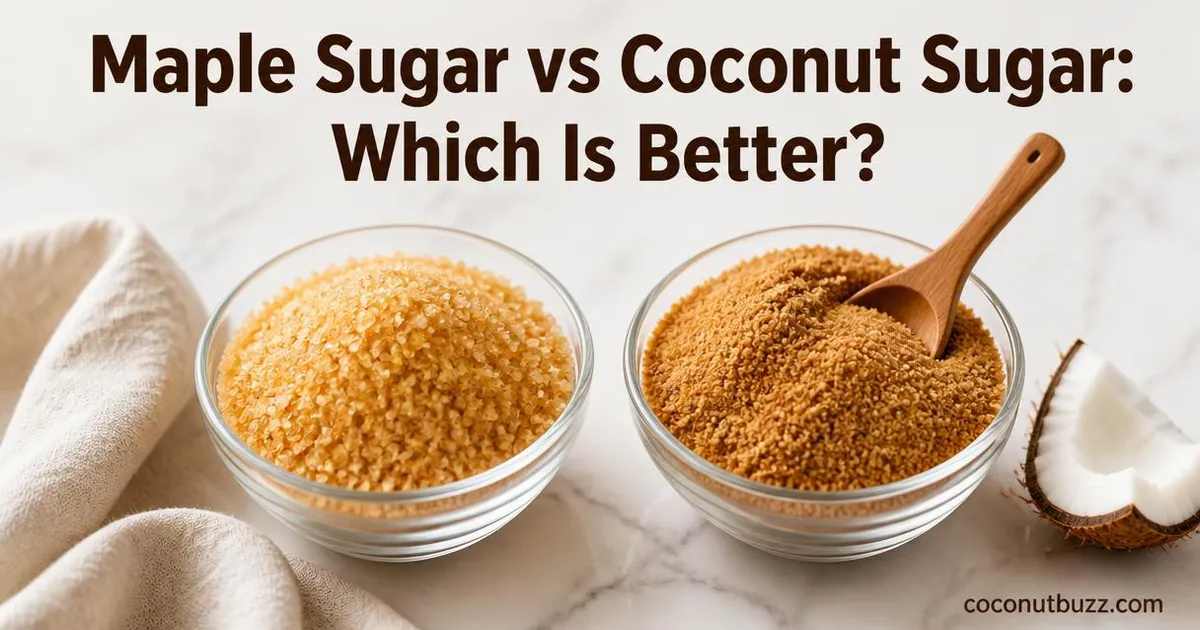
Maple Sugar vs Coconut Sugar: Which Is Better?
You’re standing in the baking aisle trying to decide between two granulated sweeteners that both claim to be better than white sugar. Maple sugar and coconut sugar sit side by side, and the packaging for both makes them sound like the smarter choice. But they taste different, behave differently in recipes, and come from completely different plants.
The right pick depends on what you’re making, how you want it to taste, and how your body handles sugar.
Key Takeaways
- Maple sugar tastes like concentrated maple-caramel; coconut sugar is milder with light molasses notes that stay in the background.
- Similar calories, both added sugars – neither is a health food, and both raise blood sugar.
- Some sources suggest coconut sugar may have a lower GI than maple sugar, though both affect blood sugar.
- Substituting one for the other is usually one-to-one, but flavor and moisture will shift in the final dish.
- Maple sugar suits bold-flavor recipes where you want the sweetener to contribute character; coconut sugar is a versatile brown sugar swap that fades into the background.
Maple Sugar Vs Coconut Sugar Compared
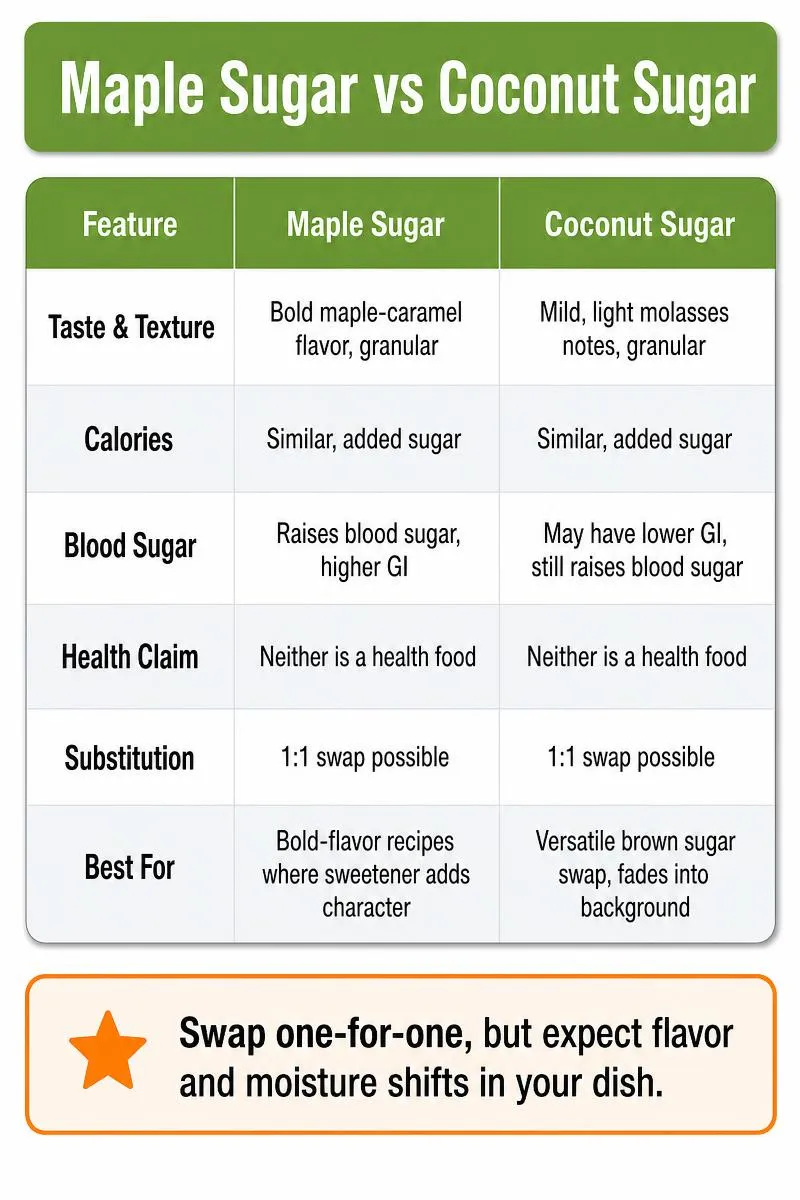
| Feature | Maple Sugar | Coconut Sugar |
|---|---|---|
| Taste & Texture | Bold maple-caramel flavor, granular | Mild, light molasses notes, granular |
| Calories | Similar, added sugar | Similar, added sugar |
| Blood Sugar | Raises blood sugar — higher GI | May have lower GI — still raises blood sugar |
| Health Claim | Neither is a health food | Neither is a health food |
| Substitution | 1:1 swap possible | 1:1 swap possible |
| Best For | Bold-flavor recipes; adds character | Versatile brown-sugar swap; fades into background |
What Is Maple Sugar?
Maple sugar starts as maple sap – the same liquid that becomes maple syrup. Producers boil the sap past the syrup stage until nearly all the water evaporates and crystals form. The result is a dry, granulated sweetener that carries the same flavor as maple syrup but in a concentrated, shelf-stable form.
Best uses: baking, dry rubs for meats, oatmeal, and anywhere you want maple flavor without adding liquid to the recipe. Because maple sugar is dry, it sweetens without thinning out batters or doughs the way syrup would.
Key strengths: Maple sugar delivers an intense caramel-maple taste that refined sugar simply cannot replicate. The dry texture means it doesn’t alter recipe moisture the way liquid sweeteners do. The flavor is potent enough that smaller amounts still carry maple character.
Main weaknesses: Maple sugar is harder to find than most natural sweeteners – you won’t always spot it in a standard grocery store. It’s usually pricier than coconut sugar, and its strong flavor can overpower delicate dishes where you just want clean sweetness.
Keep Reading
A direct comparison of turbinado and coconut sugar that explains their sweetness, texture, and baking uses.
What Is Coconut Sugar?
Coconut sugar comes from the sap of coconut palm flower buds, not from the coconut fruit itself. Harvesters cut the flower buds, collect the sap, and dehydrate it into granules. The process skips the bleaching, bone char filtering, and molasses separation that white sugar goes through – the sap heats, thickens, and dries, and that’s the whole process.
Best uses: a one-to-one replacement for brown sugar in baking, sauces, coffee, and anything that calls for brown sugar’s soft, molasses-like flavor.
Key strengths: Coconut sugar has a mild flavor that works across recipes without dominating. It’s widely available in most grocery stores and natural food shops. In recipes, coconut sugar behaves much like brown sugar – similar moisture, similar texture, similar browning.
Main weaknesses: Coconut sugar clumps in humidity, so you’ll want an airtight container. The subtle taste may disappoint anyone who wants a sweetener with real character or a distinctive flavor profile.
Maple Sugar vs Coconut Sugar: Taste and Texture
Maple sugar and coconut sugar taste noticeably different.
Maple sugar has a concentrated caramel-maple taste – think of maple syrup reduced to its most intense form. It dissolves cleanly and leaves a distinct flavor behind that reads as maple in everything from cookies to dry rubs.
Coconut sugar offers softer molasses-like notes that stay mild. The sweetness is round and toasty without pointing to any specific flavor. Where maple sugar announces itself, coconut sugar blends in.
Our pick: Maple sugar for standout flavor that you want people to notice. Coconut sugar for background sweetness that lets other ingredients lead.
Explore More
Side-by-side coverage of how coconut sugar and honey differ in flavor, nutrition, and effects on blood sugar.
Maple Sugar vs Coconut Sugar: Nutrition and Blood Sugar Impact
Calorie and carbohydrate content for both sweeteners is similar to refined white sugar – neither is low-calorie, and both are primarily sucrose. If you’re counting carbohydrates, the numbers are close enough that swapping one for the other won’t make a meaningful difference.
The glycemic index (GI) is where these two sweeteners may differ. Some sources suggest coconut sugar may have a lower glycemic index than maple sugar and many other sweeteners. Coconut sugar contains small amounts of inulin – a fiber that may slow how fast the sugar hits your bloodstream. Maple sugar does not contain significant amounts of inulin.
GI values can vary based on how each batch is processed, and both sweeteners still raise blood sugar. The GI discussion is relevant if you’re monitoring blood sugar, but it doesn’t make either sweetener a free pass.
Both maple sugar and coconut sugar are added sugars with calories and carbohydrates comparable to refined sugar. Portion control matters more than which sugar you choose. If you’re using small amounts, the differences are modest. If you’re using large amounts, neither one is the better choice – you’re still consuming a significant dose of sugar.
Maple Sugar vs Coconut Sugar: Baking and Substituting
The substitution ratio between maple sugar and coconut sugar is roughly one-to-one, and the same holds when substituting either for refined sugar. You won’t need to adjust quantities – but you will notice differences in the final product.
Maple sugar is dry, which means it doesn’t add moisture to baked goods. That’s useful in recipes where extra liquid would throw off the texture – shortbread, certain cookies, and dry rubs. But the intense maple flavor comes through strongly, so it works best in recipes where that flavor is welcome: granola, spiced cakes, oatmeal cookies, and anything with warm spices.
Coconut sugar carries a bit more moisture and behaves like brown sugar in recipes. It browns nicely, adds chewiness to cookies, and dissolves well in liquids. The mild flavor means coconut sugar won’t compete with vanilla, chocolate, fruit, or other primary flavors – it just sweetens.
Our pick: Coconut sugar as a default brown sugar substitute that works across most recipes. Maple sugar when you specifically want maple flavor and a dry texture.
Worth Reading Next
Creamed coconut vs coconut cream
Practical guidance on using different coconut forms in recipes, useful when substituting sweeteners in baking.
Which Should You Choose?
- Bold maple flavor in granola or rubs → Maple sugar. The concentrated taste is the point, and the dry texture keeps rubs and coatings crisp.
- Direct brown sugar replacement that stays in the background → Coconut sugar. It mimics brown sugar’s moisture and mild molasses notes without changing the character of the recipe.
- Watching blood sugar and want the option discussed as lower glycemic → Coconut sugar, cautiously. Some sources point to a lower GI, but both are still added sugars that raise blood glucose.
- Prefer a North American-produced sweetener → Maple sugar. Maple sap is harvested in the northeastern US and eastern Canada, so the supply chain is shorter.
- Want the most affordable, widely available natural granulated option → Coconut sugar. It’s easier to find in stores and typically costs less per ounce than maple sugar.
FAQs About Maple Sugar and Coconut Sugar
Which is healthier, maple sugar or coconut sugar?
Neither is a health food – both deliver similar calories and carbohydrates. Coconut sugar contains small amounts of inulin, a fiber that may slow sugar absorption, which is why it is sometimes discussed as the marginally better option. But the practical difference is small, and portion size matters more than which sweetener you pick.
Can you substitute coconut sugar for maple sugar?
Yes, in most recipes the substitution is one-to-one. The main changes will be flavor – coconut sugar is milder and lacks the maple-caramel intensity – and moisture, since coconut sugar behaves more like brown sugar and carries slightly more moisture than dry maple sugar.
Which is safer for diabetics, maple sugar or coconut sugar?
Neither sweetener is a safe choice for unrestricted consumption if you’re managing diabetes. Both raise blood sugar. As noted above, coconut sugar’s inulin may give it a lower GI, but that doesn’t make it diabetic-friendly. Anyone monitoring blood glucose should treat both as added sugars and consult a doctor or dietitian for personalized guidance.
What are the downsides of coconut sugar?
Coconut sugar clumps in humid conditions, so you need an airtight storage container. The flavor is subtle – if you want a sweetener with character, coconut sugar may feel bland. And it’s still an added sugar with calories and carbohydrates comparable to white sugar.
What is the healthiest sugar to buy?
There’s no sugar that qualifies as genuinely healthy. The least processed options – like coconut sugar, maple sugar, raw honey, and date sugar – retain trace minerals and compounds that refined white sugar loses, but the amounts are small. The healthiest approach is using less sugar overall, regardless of source.
What is the least healthy sugar?
Highly refined white sugar and high-fructose corn syrup are the most processed options, stripped of all mineral content and fiber. They cause rapid blood sugar spikes without any mitigating compounds. Both maple sugar and coconut sugar are less processed alternatives.
How do maple sugar and coconut sugar compare in taste?
Maple sugar has a concentrated caramel-maple flavor that reads clearly in any recipe. Coconut sugar has mild molasses-like notes that stay in the background. If you want the sweetener to contribute flavor, maple sugar wins. If you want it to sweeten without changing the flavor profile, coconut sugar is the better pick.
Which is better for weight loss, maple sugar or coconut sugar?
Neither sweetener supports weight loss – both are calorie-dense added sugars. The calorie content is similar enough that swapping one for the other won’t affect weight management. Reducing total sugar intake is the strategy that actually moves the needle.
How do maple sugar and coconut sugar compare to honey?
Honey is a liquid sweetener, so it changes recipe moisture in ways both maple sugar and coconut sugar do not. Honey has a distinct floral flavor that’s different from both maple and coconut sugar’s profiles. Nutritionally, honey is also an added sugar with similar calories. Coconut sugar is the easiest granulated swap for brown sugar; maple sugar is the closest dry equivalent to maple syrup; honey is best when a liquid sweetener with floral notes is what a recipe calls for.
Where do maple sugar and coconut sugar fall on a good sugar versus bad sugar list?
Both rank above highly refined white sugar and high-fructose corn syrup because they’re less processed and retain trace compounds – inulin in coconut sugar, trace minerals in maple sugar. Both rank below fruit-based sweeteners like mashed dates, which carry fiber and nutrients alongside their sugar content. In practical terms, they’re middle-of-the-pack: better than refined sugar, not as good as whole fruit.
Final Thoughts
Neither maple sugar nor coconut sugar is a health food, but both are reasonable alternatives to refined white sugar when you use them sparingly.
Choose maple sugar if flavor impact and domestic sourcing matter most to you. The concentrated maple-caramel taste adds maple-caramel flavor to granola, rubs, and spiced baked goods, and the shorter North American supply chain is a plus.
Choose coconut sugar if you want a mild, versatile brown sugar substitute that’s easier to find and typically more affordable. Coconut sugar works across recipes without competing with other flavors.
Next step: test both in your favorite cookie recipe. Bake one batch with maple sugar and one with coconut sugar using a one-to-one swap, then taste them side by side. The difference will be obvious – and you’ll know immediately which one belongs in your pantry.
External References
- The Best and Worst Sweeteners, Ranked by GI Index – Goodrx
- Get the Facts: Added Sugars | Nutrition – Cdc
- USDA FoodData Central – Usda
- Which is healthier: Agave, maple, or coconut sugar? – Org
- Coconut Sugar: Chemical Analysis and Nutritional Profile – PMC – NIH
- Coconut sugar vs white sugar: Which one is healthier? – Theglobeandmail