Turbinado Sugar vs Coconut Sugar: Which to Choose?
You’re standing in the baking aisle looking at two bags of brown sugar alternatives, wondering if either one is actually worth the extra cost. Turbinado sugar and coconut sugar both get marketed as healthier swaps for white sugar, but they come from completely different sources and behave differently in your kitchen. The choice between them depends on what you’re making, whether blood sugar matters to you, and whether you care about flavor differences.
Key Takeaways
- Turbinado sugar is minimally processed cane sugar with large crystals and a mild molasses flavor, while coconut sugar comes from coconut palm sap and tastes like caramel
- Coconut sugar has a lower glycemic index than turbinado, which may matter if you’re watching blood sugar
- Turbinado dissolves slower and adds crunch to baked goods, while coconut sugar dissolves easily and works in most recipes as a 1:1 substitute
- Both contain trace minerals, but not enough to make a meaningful nutritional difference
- Coconut sugar costs roughly twice as much as turbinado in most stores
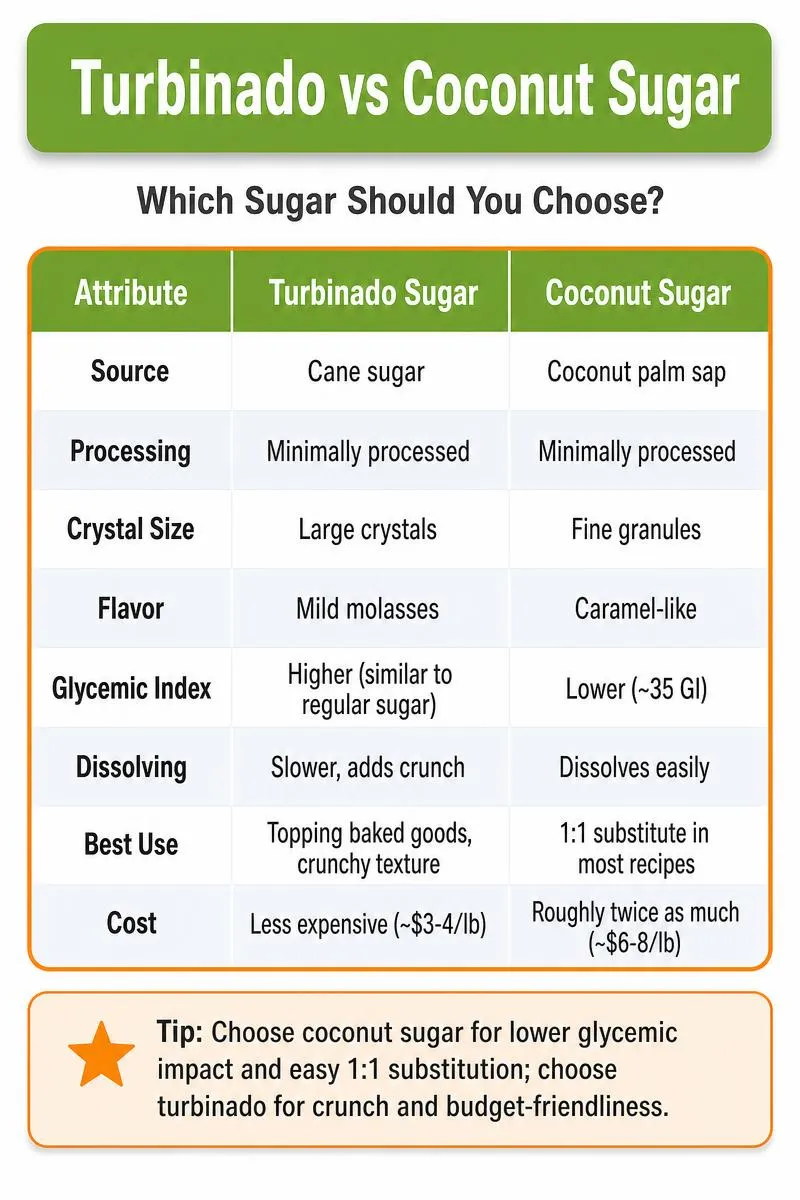
Turbinado Sugar Vs Coconut Sugar Quick Comparison
| Attribute | Turbinado Sugar | Coconut Sugar |
|---|---|---|
| Source | Cane sugar | Coconut palm sap |
| Processing | Minimally processed | Minimally processed |
| Crystal size | Large crystals | Fine granules |
| Flavor | Mild molasses | Caramel-like |
| Glycemic index | Higher (similar to regular sugar) | Lower (~35 GI) |
| Dissolving | Slower, adds crunch | Dissolves easily |
| Best use | Topping; adds crunch | 1:1 substitute in most recipes |
| Cost | Less expensive (~$3–4/lb) | Roughly twice (~$6–8/lb) |
What Is Turbinado Sugar?
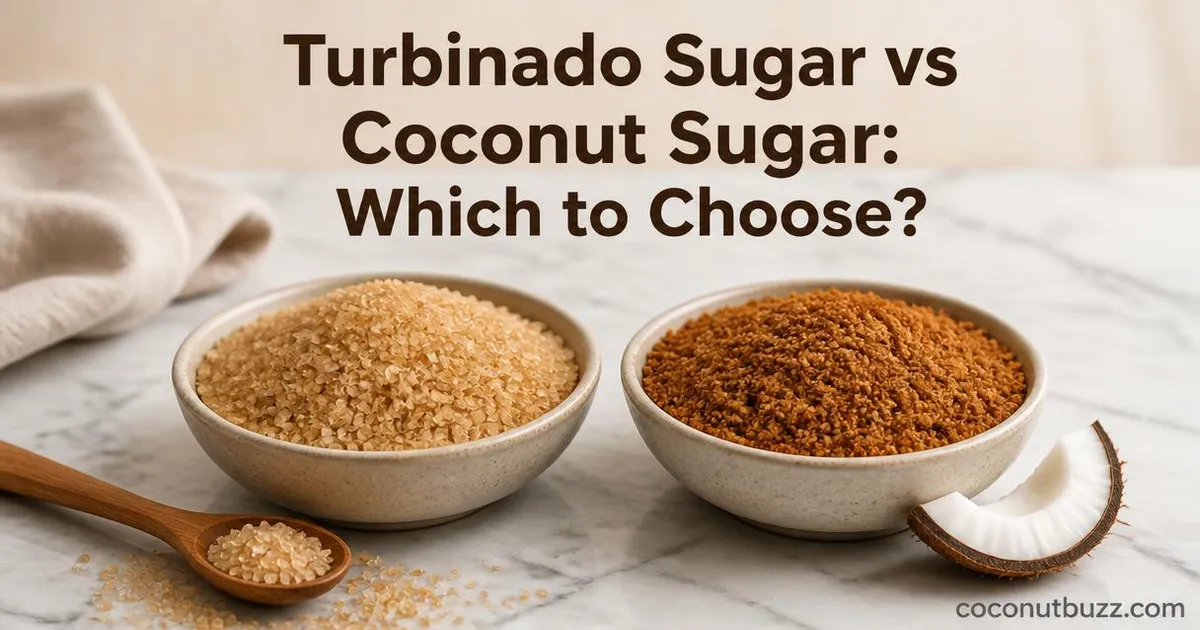
Turbinado is partially refined cane sugar – the refining process stops early, leaving some molasses on the crystals. That molasses gives turbinado its light golden color and a subtle flavor that most people barely notice in baked goods.
The crystals are large and coarse, which makes turbinado ideal when you want texture. Sprinkling turbinado over muffin tops, cookie crusts, or coffee drinks gives you a visible sparkle and a crunch you can’t get from finer sugars. That same coarseness means turbinado dissolves more slowly than white sugar, which limits its usefulness in recipes where you need sugar to fully incorporate.
Related Reading
A detailed look at the health benefits and nutritional profile of coconut sugar to help readers evaluate it against…
What Is Coconut Sugar?
Coconut sugar comes from the sap of coconut palm trees. Harvesters collect the sap, boil it down, and crystallize it – no bleaching, no molasses separation. The result is a dark brown sugar with fine to medium crystals.
The flavor is distinctly caramel, sometimes described as earthy or butterscotch-like. Coconut sugar dissolves easily and substitutes 1:1 for white or brown sugar in most recipes, which makes it a straightforward swap. Some sources suggest coconut sugar retains small amounts of iron, zinc, and potassium from the palm sap.
Coconut sugar is less widely available than turbinado, though most natural food stores and online retailers carry it.
Turbinado Sugar vs Coconut Sugar: Glycemic Index
Coconut sugar has a lower glycemic index than turbinado. Coconut sugar causes a slower rise in blood glucose after eating compared to turbinado.
That difference may matter if you’re managing diabetes or trying to avoid blood sugar spikes. Both are still sugar and both affect blood glucose – just at different speeds. Portion size matters more than sugar type for overall blood sugar control, so neither one gives you a free pass to eat more.
Turbinado Sugar vs Coconut Sugar: Taste and Texture
Turbinado has a light molasses note that’s barely noticeable in most recipes. Coconut sugar brings a stronger caramel flavor that can shift the taste of delicate baked goods – sometimes welcome, sometimes not.
Turbinado’s large crystals add crunch when sprinkled on top of muffins or cookies. Coconut sugar’s finer texture blends into batters and doughs without leaving grit behind. Neither tastes like coconut or pure cane, but coconut sugar’s flavor is more assertive and harder to ignore.
The winner depends on what you’re making. Turbinado shines when texture matters. Coconut sugar works better when you need even sweetness throughout.
Worth Reading Next
A comparison that highlights taste, texture, and uses which complements the taste/texture discussion in this article.
Turbinado Sugar vs Coconut Sugar: Best Uses
Turbinado wins for topping muffins, scones, and cookies where you want visible sparkle and crunch. Its large crystals hold their shape during baking, so you get that finishing texture white sugar can’t provide.
Coconut sugar works better in cakes, brownies, and recipes where the sugar needs to fully incorporate. It dissolves easily into batters and doughs, so you don’t end up with pockets of undissolved crystals.
Turbinado dissolves slowly in cold drinks – not ideal for iced coffee or lemonade. Coconut sugar handles cold liquids better, though its caramel flavor changes the drink’s taste.
Coconut sugar also complements chocolate and spice-based recipes well. When you don’t want to alter the intended flavor profile, turbinado is the safer choice.
Turbinado Sugar vs Coconut Sugar: Cost and Availability
Turbinado is available in nearly every grocery store, often under the brand name Sugar in the Raw. Coconut sugar is more common in natural food stores or online, though mainstream supermarkets increasingly carry it.
Turbinado typically costs about the same as organic cane sugar. Coconut sugar runs roughly double the price of turbinado per pound. If you’re baking in volume, that cost difference adds up quickly – a batch of cookies won’t break the budget, but regular baking with coconut sugar costs noticeably more over time.
Which Should You Choose?
If you’re managing blood sugar or following a low-glycemic diet, coconut sugar offers a lower glycemic index that may help reduce spikes. If you want a neutral-tasting sugar that works in any recipe without changing the flavor, turbinado is the safer bet.
For topping baked goods where crunch and visual appeal matter, turbinado wins. For something that dissolves easily and substitutes directly for brown sugar, coconut sugar works better. If cost matters and you use sugar often, turbinado is the more economical choice.
Worth Reading Next
Practical baking alternatives and uses for coconut-based ingredients that readers may explore when deciding which…
FAQs About Turbinado Sugar and Coconut Sugar
Can I substitute coconut sugar for turbinado sugar?
Yes, in most recipes they substitute 1:1. Expect a slightly different flavor – coconut sugar’s caramel note is stronger – and a finer texture without the crunch turbinado provides.
What are the downsides of coconut sugar?
Higher cost, a stronger flavor that can alter recipes, and less availability than turbinado. Some stores don’t carry it at all.
Is turbinado sugar unhealthy?
Turbinado is still sugar with the same calorie count as white sugar. The only difference is that some molasses stays on the crystals – not enough to meaningfully change its nutritional profile.
Which has more nutrients, turbinado or coconut sugar?
Both contain trace minerals – turbinado retains some from molasses, and coconut sugar retains iron, zinc, and potassium from palm sap. The amounts are too small to meaningfully impact nutrition in either case.
Does coconut sugar work for weight loss better than turbinado?
No. Both have essentially the same calories per teaspoon and affect weight the same way. Neither sugar supports weight loss on its own.
What’s the best replacement for turbinado sugar if I don’t have it?
White sugar mixed with a tiny bit of molasses gets you close. Regular brown sugar also works in a pinch, though it has a softer texture and finer crystals.
Final Verdict
Neither sugar is dramatically healthier than the other, despite the marketing. Coconut sugar’s lower glycemic index gives it a real edge if blood sugar control matters to you, and its fine texture makes it easier to use across different recipes. Turbinado is better when you want texture, need to keep costs down, or prefer a flavor that won’t interfere with what you’re making.
Keep turbinado for finishing touches and coconut sugar for everyday substitution if you want both in your pantry. Start with whichever fits the majority of your baking needs.
External References