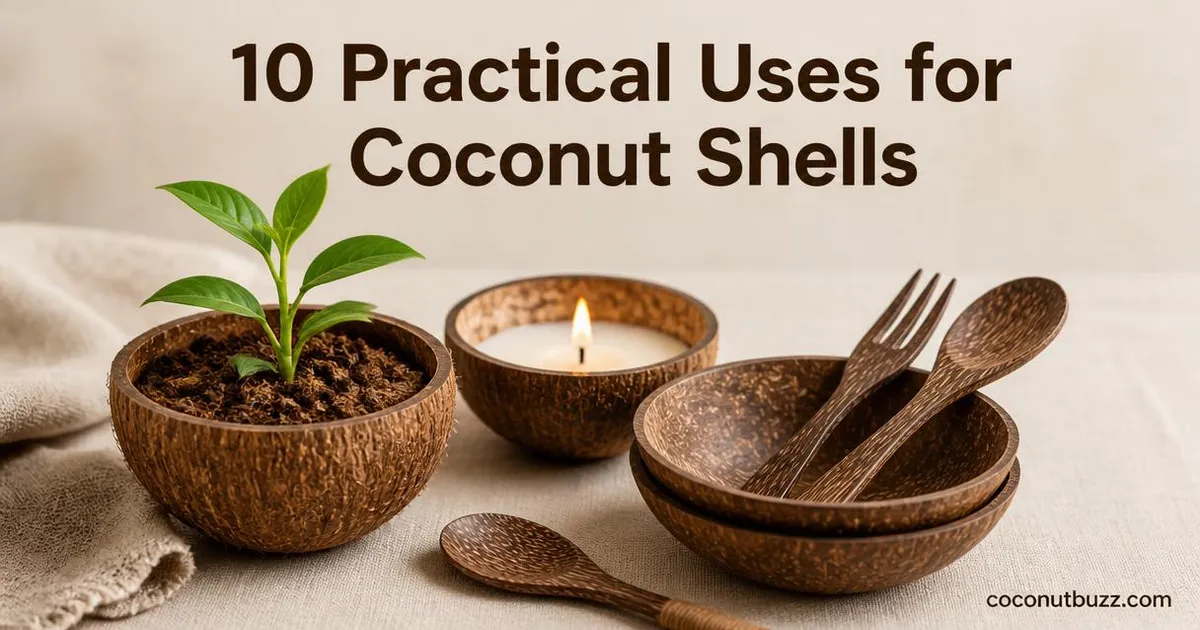
10 Practical Uses for Coconut Shells
Most people crack open a coconut, scoop out the meat, and toss the shell in the trash. That hard woody layer is actually one of the most versatile parts of the coconut, with uses ranging from handmade bowls to industrial-grade filtration media.
Some of these uses you can do at home with nothing but a saw and some sandpaper. Others, like activated carbon and charcoal briquettes, require industrial processing you will not be doing in your kitchen.
Key Takeaways
- The coconut shell is the hard layer between the meat and the fibrous husk. It is dense, durable, and fully biodegradable.
- Everyday uses include bowls, candles, crafts, and planters. Industrial uses include charcoal briquettes and activated carbon.
- Shell-based activated carbon is used in water and air filtration because of its dense pore structure.
- Old shells can be reused at home or composted instead of thrown away.
- When buying coconut shell products, look at durability and craftsmanship rather than price alone. Well-made pieces last and cost less over time.
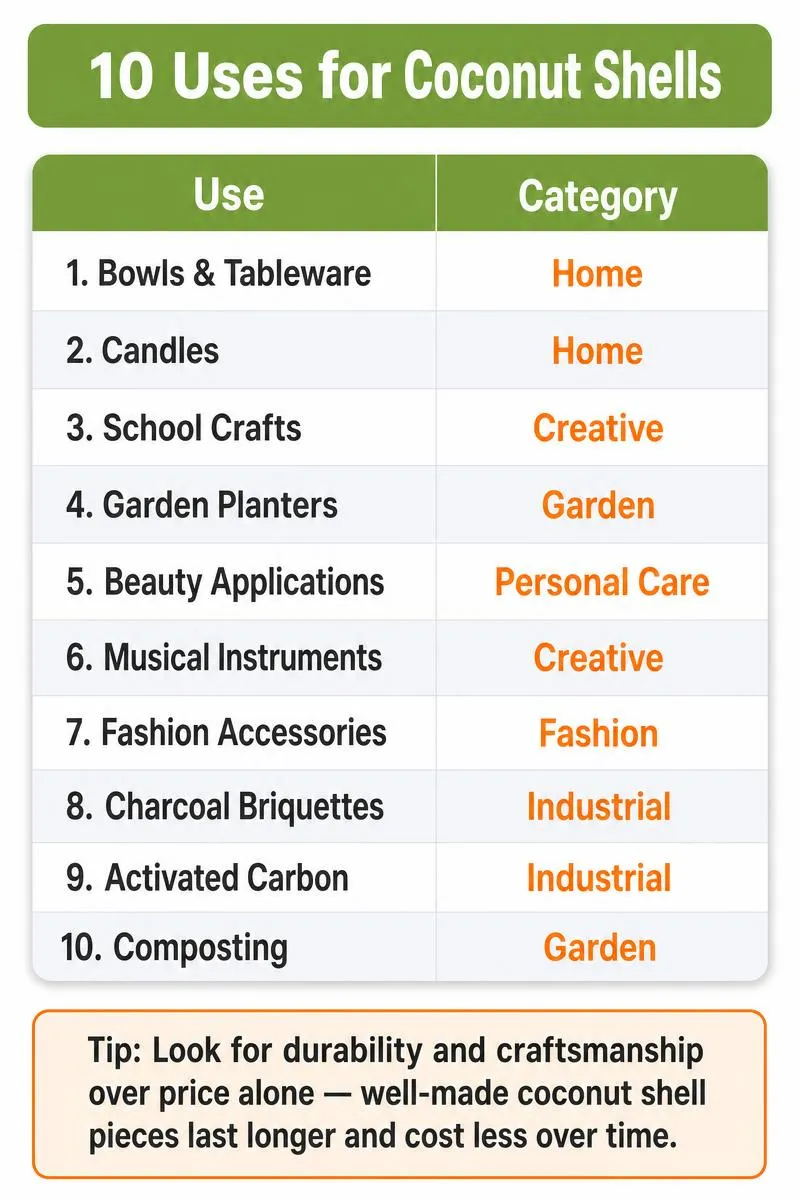
Coconut Shell Uses at a Glance
| Use | Category |
|---|---|
| Bowls & Tableware | Home |
| Candles | Home |
| School Crafts | Creative |
| Garden Planters | Garden |
| Beauty Applications | Personal Care |
| Musical Instruments | Creative |
| Fashion Accessories | Fashion |
| Charcoal Briquettes | Industrial |
| Activated Carbon | Industrial |
| Composting | Garden |
What Are Coconut Shells?
The coconut shell is the hard, woody layer that sits between the white meat inside and the fibrous husk outside. A lot of people confuse the shell with the husk, but they are different parts. The husk is the thick, stringy outer layer. The shell is the smooth, hard bowl that holds the meat and coconut water.
Shells are dense and long-lasting, which is why they work for everything from dishware to charcoal. They are also biodegradable, so they break down naturally over time. Since coconuts are harvested in large quantities worldwide, shells are an abundant agricultural byproduct that often goes to waste.
Keep Reading
Shop finished coconut-shell jewelry examples and product options to inspire DIY projects and gifts.
10 Uses of Coconut Shells
Here are ten ways coconut shells get reused, starting with what you can do at home and moving into industrial applications.
1. Coconut Shell Bowls and Tableware
Half-shell coconut bowls are one of the most common reused shell products. They are hard, food-safe when properly finished, and they replace plastic or disposable dishware in a household.
A well-made coconut shell bowl holds up to regular use if it has been sanded smooth and sealed with a food-safe finish. Cheap ones that skip the finishing step can crack or splinter after a few washes.
2. Coconut Shell Candles
Half and whole shells work as natural candle holders. The hard shell withstands heat from a burning wick, and the shape gives you a rustic-looking container without buying anything new.
If you make your own, pour melted wax directly into a cleaned half-shell and set a wick in the center. Shell candles fit well in homes that lean toward natural materials rather than mass-produced decor.
3. Coconut Shell Craft Projects for School
Coconut shells are popular for school craft projects. They are free, sturdy, and can be cut into shapes that work for masks, animal figures, and decorative pieces.
Parents and teachers can clean the shell, let it dry, and hand it to kids with basic cutting and painting supplies. Younger children will need help cutting through the hard shell, but older students can handle simple tools with supervision.
4. Coconut Shell Uses in the Garden
Halved shells make small planters for succulents, herbs, or seed starts. They also work as decorative garden accents, lined along a path or grouped in a container arrangement.
The shell holds soil and drains reasonably well if you drill a small hole in the bottom. Over time the shell breaks down naturally, so you can plant the whole thing directly in the ground once a seedling outgrows it.
5. Beauty Applications
Some beauty products use finely ground coconut shell as an exfoliating scrub ingredient. The shell particles provide physical exfoliation, and some sources suggest they help with removing dead skin.
Coconut shell charcoal also appears in skincare products, particularly in cleansers and masks. The charcoal is valued for its ability to bind to substances, which is the same property that makes it useful in filtration.
6. Musical Instruments
Coconut shells serve as bodies or resonating chambers in certain musical instruments. The hard, rounded shape creates natural acoustic properties that suit percussion and stringed designs.
Musicians and instrument collectors who work with natural materials sometimes prefer shell-based construction for its tonal qualities. Specific instruments vary, but the shell’s density and hollow form make it a practical material for sound applications.
7. Fashion Accessories
Shells turn up in wearable accessories like buttons, beads, and pendants. The hardness of the material means it holds a polish and resists everyday wear better than softer natural materials.
Buyers who prefer natural-goods accessories over synthetic ones often find shell-based pieces appealing. The surface takes dye and engraving well, which gives makers room to add detail.
8. Coconut Shell Charcoal Briquettes
Coconut shell charcoal is made by burning shells in a low-oxygen environment, a process called carbonization. The resulting charcoal is then compressed into briquettes for grilling and cooking fuel.
Shell charcoal briquettes are valued for burning longer and producing less smoke than some other charcoal types. The density of the shell creates a charcoal that holds heat steadily, which is useful for both grilling and indoor heating in regions where that is common.
9. Activated Carbon From Coconut Shells
Activated carbon is produced by treating coconut shell charcoal with steam or heat at high temperatures. This process creates a dense network of microscopic pores throughout the carbon.
Those pores are what make shell-based activated carbon effective at trapping impurities in water and air. It is used in household water filters, air purifiers, and industrial purification systems. Coconut shell activated carbon is particularly valued because the shell’s structure produces a high density of fine pores compared to other carbon sources.
10. Composting Coconut Shells
If you have no use for an old shell, composting is a clean end-of-life option. The shell is fully biodegradable and breaks down over time in a compost pile or garden bed.
Shells take longer to decompose than softer organic matter, so crushing or breaking them into smaller pieces speeds up the process. Once broken down, the shell material adds carbon-rich matter back to the soil.
How to Choose Coconut Shell Products
A durable coconut shell product has been properly dried, sanded, and finished. A shell that skips those steps will crack or splinter quickly under regular use.
Hardness matters. A thick, dense shell resists drops and heat better than a thin one. Look at the finish too – a smooth, sealed surface tells you the maker put effort into making the piece last.
Price follows quality. Well-made shell products cost more upfront, but they hold up over months or years of use. A thin planter that splits at the seam after one season is no better than one that never had a drainage hole.
Ethical craftsmanship matters in shell craft because much of it comes from regions where coconut farming is a major industry. Buying from makers who pay fair wages and source shells sustainably supports the people doing the work, not just the product.
Worth Reading Next
A clear breakdown of coconut varieties and shell thickness to help you choose the best shells for bowls, crafts, or…
FAQs About Coconut Shells
What can you do with old coconut shells?
You can clean them and reuse them as bowls, planters, candle holders, or craft material. If you have no use for them, compost them or break them into pieces for your garden soil.
Are coconut shells compostable?
Yes. Coconut shells are fully biodegradable and break down in a compost pile. Crushing them first speeds up decomposition since the hard shell takes longer than softer plant material.
What is the difference between a coconut shell and a coconut husk?
The husk is the thick, fibrous outer layer you see on a whole coconut. The shell is the hard, woody layer inside the husk that holds the meat and water.
What are green coconuts used for?
Green coconuts are harvested mainly for their coconut water and soft meat. The shell is thinner and less developed than in mature coconuts, so it is not the primary product.
How much does coconut shell cost per kilogram?
Pricing varies widely depending on region, quality, and whether the shell is raw or processed. No reliable per-kilogram figures are available across markets, so check local suppliers for current rates.
Is coconut shell charcoal better than regular charcoal?
Coconut shell charcoal burns longer and produces less smoke than many wood-based charcoals because of the shell’s density. The carbonization process also makes use of an agricultural byproduct that would otherwise go to waste.
Explains how different palm species affect coconut size and shell availability-useful when sourcing shells for projects.
Final Thoughts
Coconut shells are worth keeping rather than tossing. You can reuse them at home for bowls, planters, or crafts, and they also feed into real industrial products like charcoal briquettes and activated carbon. When you are done with a shell, it composts cleanly.
Next time you open a coconut, try turning the shell into a small bowl or planter before you buy anything new.
External References
- What is coconut shell activated carbon? Why is it widely used … – Emidas
- Is activated charcoal safe and eco-friendly? – Eskinstore
- Indoor Air Pollution and Health Hazards Caused … – Jafanda
- Benefits of Using Coconut Shell Based Activated Carbons – Nmfiltermedia
- View of Cosmetic uses of activated charcoal – Ijcmph