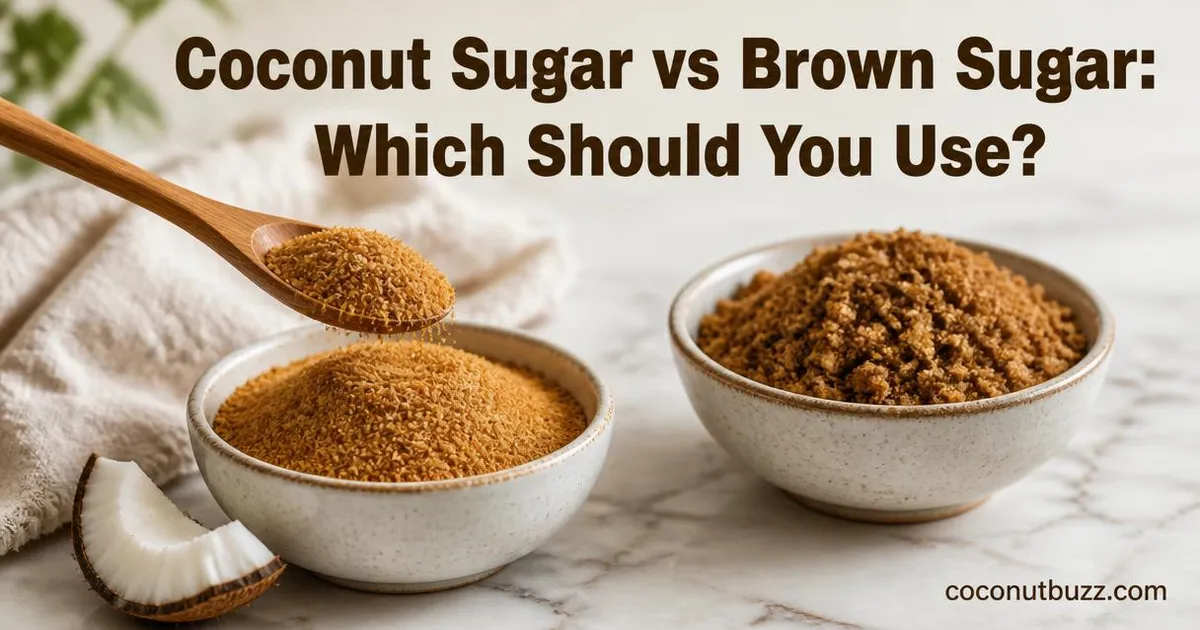
Coconut Sugar vs Brown Sugar: Which Should You Use?
Coconut sugar gets sold as the smarter choice – less processed, lower glycemic index, trace minerals. Brown sugar is just white sugar with molasses added back in. On paper, coconut sugar sounds like the obvious winner, but the actual differences between the two are smaller than the marketing suggests.
Both sugars land at roughly the same calorie count per serving. Both are mostly sucrose. The mineral content in coconut sugar exists, but in amounts too small to matter nutritionally. And while coconut sugar does have a lower glycemic index, it still raises blood sugar – just somewhat more slowly.
If you’re deciding between the two, the real question isn’t which one is “healthier.” It’s which one fits what you’re actually doing: baking, sweetening coffee, or managing blood sugar.
Key Takeaways
- Coconut sugar and brown sugar provide roughly the same calories per serving, so neither gives you a weight-loss edge
- Coconut sugar has a lower glycemic index than brown sugar, but both still raise blood sugar and aren’t safe for unrestricted use by diabetics
- Brown sugar is refined white sugar with molasses added back, while coconut sugar comes from the sap of coconut palm flowers
- The trace minerals in coconut sugar – iron, zinc, potassium – exist in amounts too small to make a meaningful nutritional difference
- Brown sugar performs better in traditional baking where moisture and caramel flavor matter; coconut sugar works where you want a less processed option
Coconut Sugar Vs Brown Sugar Side-by-Side
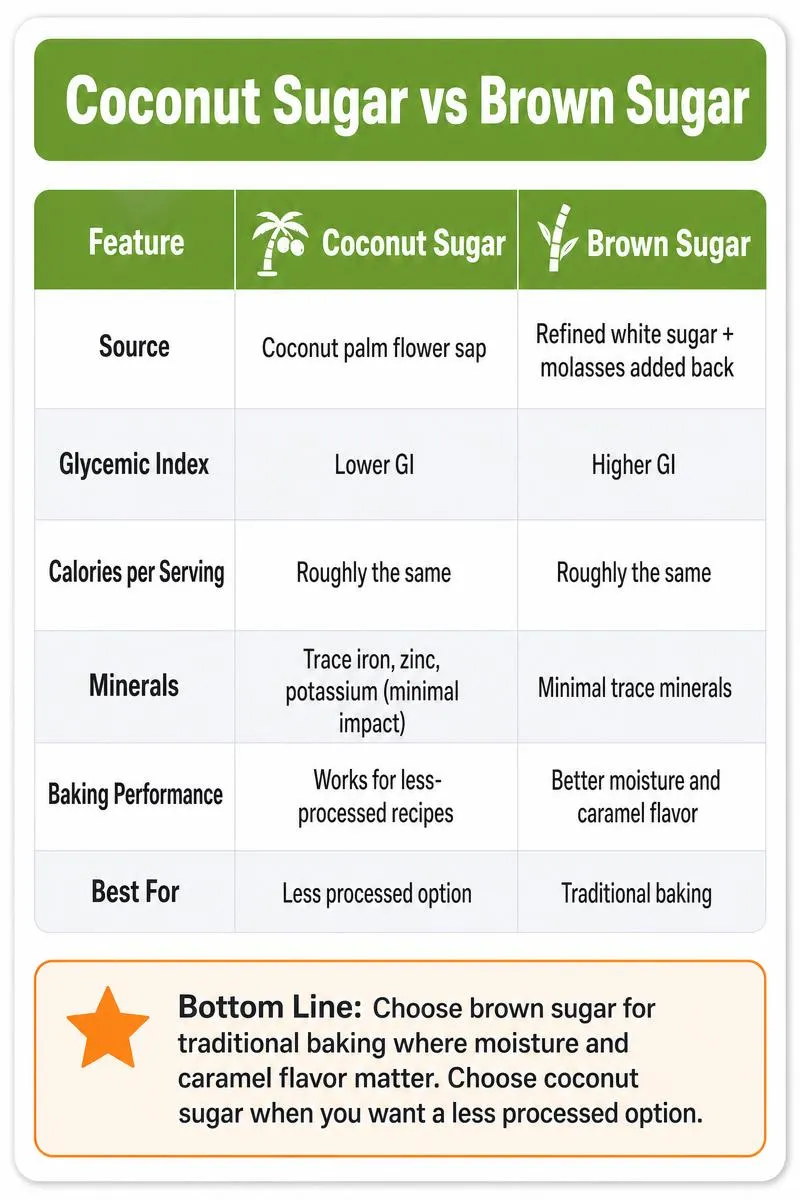
| Feature | Coconut Sugar | Brown Sugar |
|---|---|---|
| Source | Coconut palm flower sap | Refined white sugar + molasses |
| Glycemic Index | Lower GI | Higher GI |
| Calories per Serving | Roughly the same | Roughly the same |
| Minerals | Trace iron, zinc, potassium | Minimal trace minerals |
| Baking Performance | Works for less-processed recipes | Better moisture & caramel flavor |
| Best For | Less processed option | Traditional baking |
What Is Coconut Sugar?
Coconut sugar comes from the sap of coconut palm flowers. Farmers cut the flower buds, collect the liquid sap, then heat it until it thickens and crystallizes. That process skips the bleaching, filtering, and chemical processing that refined sugar goes through.
The result is a granulated sugar with a caramel-like flavor that’s slightly deeper and less sweet than brown sugar. Coconut sugar is mostly sucrose, with small amounts of fructose and glucose – similar in composition to regular table sugar.
Coconut sugar does contain trace amounts of iron, zinc, and potassium. Coconut sugar also contains small amounts of inulin, a fiber that may slow how fast the sugar hits your bloodstream. But the quantities are small enough that you’d need to eat impractical amounts to get a useful dose of any of these nutrients.
Coconut sugar costs more and appears mainly in health food stores or specialty sections rather than mainstream baking aisles.
A breakdown of coconut sugar’s vitamins, minerals, and potential health perks.
What Is Brown Sugar?
Brown sugar is white sugar with molasses added back in. Light brown sugar has less molasses; dark brown sugar has more. The base sugar goes through the full refining process – extraction, bleaching, filtering – before molasses gets reintroduced.
The molasses is what gives brown sugar its moisture-retaining quality and caramel flavor. That moisture matters in baking: brown sugar keeps cookies chewy and cakes tender in ways that drier sugars can’t replicate.
Brown sugar’s molasses does contain tiny amounts of calcium and potassium, but not enough to make a nutritional difference at the serving sizes you’d actually use. The calorie count is the same as white sugar.
If a recipe calls for brown sugar, the molasses content is usually doing something specific for texture or flavor.
Coconut Sugar vs Brown Sugar: Glycemic Index
Coconut sugar has a lower glycemic index than brown sugar – some sources place coconut sugar in the low-to-moderate range, while brown sugar sits higher on the scale. A lower glycemic index means sugar enters your bloodstream more gradually rather than spiking quickly.
But slower doesn’t mean safe. Coconut sugar still raises blood sugar, and the difference in glycemic index matters less than your total sugar intake across the day. Portion size, what you eat alongside the sugar, and your individual metabolic response all affect blood sugar more than the type of sugar you choose.
Neither sugar is safe for diabetics to use freely. If you’re managing blood sugar, coconut sugar may cause a slightly more gradual rise, but treating coconut sugar as a free pass would be a mistake.
Coconut Sugar vs Brown Sugar: Nutritional Content
Both sugars provide about the same calories per teaspoon. Neither offers meaningful vitamins, and neither contains enough fiber to matter nutritionally.
Coconut sugar contains inulin, a prebiotic fiber that brown sugar lacks entirely. That’s the one nutritional difference between the two. That said, the inulin content in coconut sugar is minimal – not enough to deliver meaningful digestive benefits at typical serving sizes.
Brown sugar’s molasses provides tiny amounts of calcium and potassium, but again, not enough to matter. Both are added sugar, and health guidelines recommend limiting added sugar regardless of the source.
A teaspoon of coconut sugar is still a teaspoon of sugar.
You Might Also Like
Side-by-side comparison of coconut sugar and maple syrup for nutrition and baking swaps.
Coconut Sugar vs Brown Sugar: Baking Performance
Brown sugar adds moisture and chewiness to baked goods because of its molasses content. When you cream brown sugar with butter, the molasses helps create a structure that holds air and stays soft. That’s why classic chocolate chip cookie recipes call for brown sugar – the molasses is doing real work.
Coconut sugar is drier and grainier. Coconut sugar doesn’t cream with butter the same way, and baked goods made with coconut sugar tend to come out less moist and more crumbly. You can substitute coconut sugar one-for-one for brown sugar, but expect the texture and flavor to shift.
Coconut sugar works better in recipes where texture is less critical – oatmeal, coffee, glazes, or anything where you’re just dissolving the sugar. For traditional baking where you want predictable results, brown sugar is the more reliable choice.
Coconut Sugar vs Brown Sugar: Cost and Availability
Brown sugar is cheaper and available in every grocery store. You’ll find brown sugar in the baking aisle whether you’re at a big-box store, a corner market, or anywhere in between.
Coconut sugar costs significantly more and appears mainly in health food stores or specialty sections of larger grocery stores. If you’re baking regularly or buying in quantity, the price difference adds up quickly.
Brown sugar has an indefinite shelf life if stored in an airtight container to prevent hardening. Coconut sugar also stores well for months in a sealed container, though it’s less prone to clumping than brown sugar. Both can be revived if they dry out – brown sugar with a damp paper towel in the container, coconut sugar by breaking up clumps manually.
For everyday baking and cooking, brown sugar’s availability and price make it the more practical option. Online retailers offer coconut sugar in bulk, which reduces the per-unit cost but requires planning ahead.
Which Should You Choose?
- Baking traditional recipes – chocolate chip cookies, brownies, cakes: Brown sugar gives better texture and moisture. The molasses content does something specific that coconut sugar can’t replicate.
- Wanting a less processed option – and don’t mind paying more: Coconut sugar works well for sweetening drinks, oatmeal, or simple recipes where texture isn’t critical. The simpler production process appeals if you avoid heavily refined ingredients.
- Managing diabetes or blood sugar: Neither sugar is a free pass. Coconut sugar may cause a slightly more gradual blood sugar rise, but portion control matters more than which sugar you pick.
- On a tight budget or need consistent baking results: Brown sugar is the practical choice – cheaper, available everywhere, and predictable in recipes.
- Trying to reduce added sugar overall: Focus on using less of either one rather than switching types. Cutting back by a third in most recipes won’t noticeably change the result.
A practical look at sweetness, calories, and when to swap coconut sugar for stevia.
FAQs About Coconut Sugar and Brown Sugar
Is coconut sugar healthier than brown sugar?
Not meaningfully. Coconut sugar is less processed and has a slightly lower glycemic index, but the calorie count and mineral content are nearly identical at serving sizes you’d actually use. Both are added sugar.
Can you substitute coconut sugar for brown sugar in recipes?
Yes, you can swap them one-for-one, but expect differences in texture and moisture. Coconut sugar is drier and grainier, so baked goods may come out less chewy and more crumbly. Brown sugar is the better choice when texture matters.
Does coconut sugar have fewer calories than brown sugar?
No. Both provide roughly the same calories per teaspoon. The calorie difference between coconut sugar and brown sugar is negligible.
What are the downsides of coconut sugar?
Coconut sugar costs more, is harder to find, and doesn’t perform as well in baking. The nutrient claims that drive coconut sugar’s “healthier” reputation don’t hold up at realistic serving sizes. Coconut sugar is still sugar.
Which is better for diabetics, coconut sugar or brown sugar?
Neither should be used freely. Coconut sugar may cause a slightly slower blood sugar rise due to its lower glycemic index, but portion size and total sugar intake matter more than which type you choose.
Is coconut sugar better than white sugar?
Coconut sugar is less processed and contains trace minerals that white sugar lacks. But the mineral amounts are too small to matter nutritionally, and the calorie and sucrose content are similar. If avoiding refined ingredients matters to you, coconut sugar is the less processed option.
Does brown sugar raise blood sugar faster than coconut sugar?
Generally, yes – brown sugar has a higher glycemic index than coconut sugar. But both raise blood sugar, and the practical difference is smaller than it sounds. What you eat with the sugar and how much you use matter more.
What is the healthiest form of sugar to use?
There’s no truly healthy sugar. All forms – coconut, brown, white, honey, maple – are added sugar that health guidelines recommend limiting. The healthiest approach is using less of whatever you choose.
Final Verdict
Coconut sugar isn’t the health hero the marketing makes it out to be, but coconut sugar isn’t worse than brown sugar either. The lower glycemic index is real but modest, the mineral content is negligible at realistic servings, and the calorie count is essentially the same.
If the slightly lower glycemic index matters to you and you can afford the price difference, coconut sugar is a reasonable swap for sweetening coffee, oatmeal, or simple recipes. For baking, brown sugar performs better – the molasses content does real work for moisture and texture.
The most practical move: start by checking nutrition labels on packaged foods, where most added sugar actually comes from. That reduction does more for your health than switching sugar types ever will.
External References