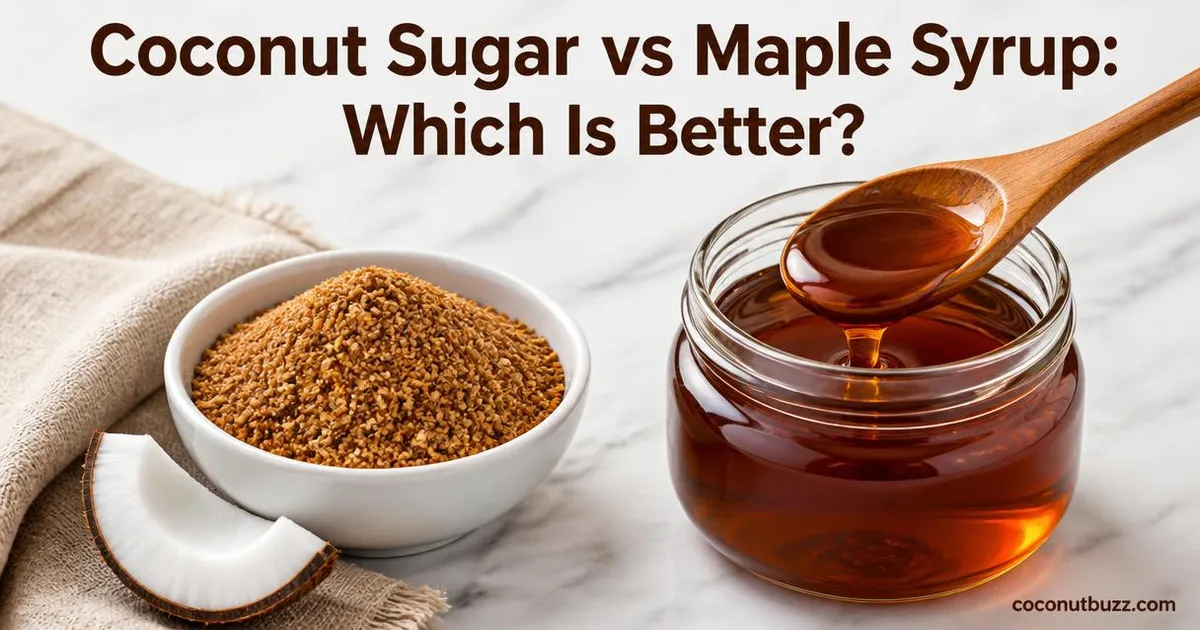
Coconut Sugar vs Maple Syrup: Which Is Better?
Coconut sugar and maple syrup both get marketed as “natural” sweeteners, but they behave differently in your kitchen and in your body. One is a dry granule that mimics brown sugar; the other is a viscous liquid with a flavor that won’t hide.
Both are still sugar – primarily sucrose – and both raise blood glucose. But they differ in glycemic impact, taste profile, and how they perform in recipes. Choosing between them comes down to what you’re making and what you’re trying to avoid.
Key Takeaways
- If you monitor blood sugar, maple syrup generally has a lower glycemic index than coconut sugar, but both still raise glucose levels.
- Coconut sugar works better as a dry granulated substitute in baking; maple syrup integrates best in liquids, marinades, and moist batters.
- Coconut sugar tastes like mild brown sugar with caramel notes; maple syrup carries a distinct woody, vanilla-forward flavor.
- Both are less processed than refined white sugar, but neither is a health food and both should be used sparingly.
- Maple syrup adds moisture to recipes, which affects baking texture more than coconut sugar does.
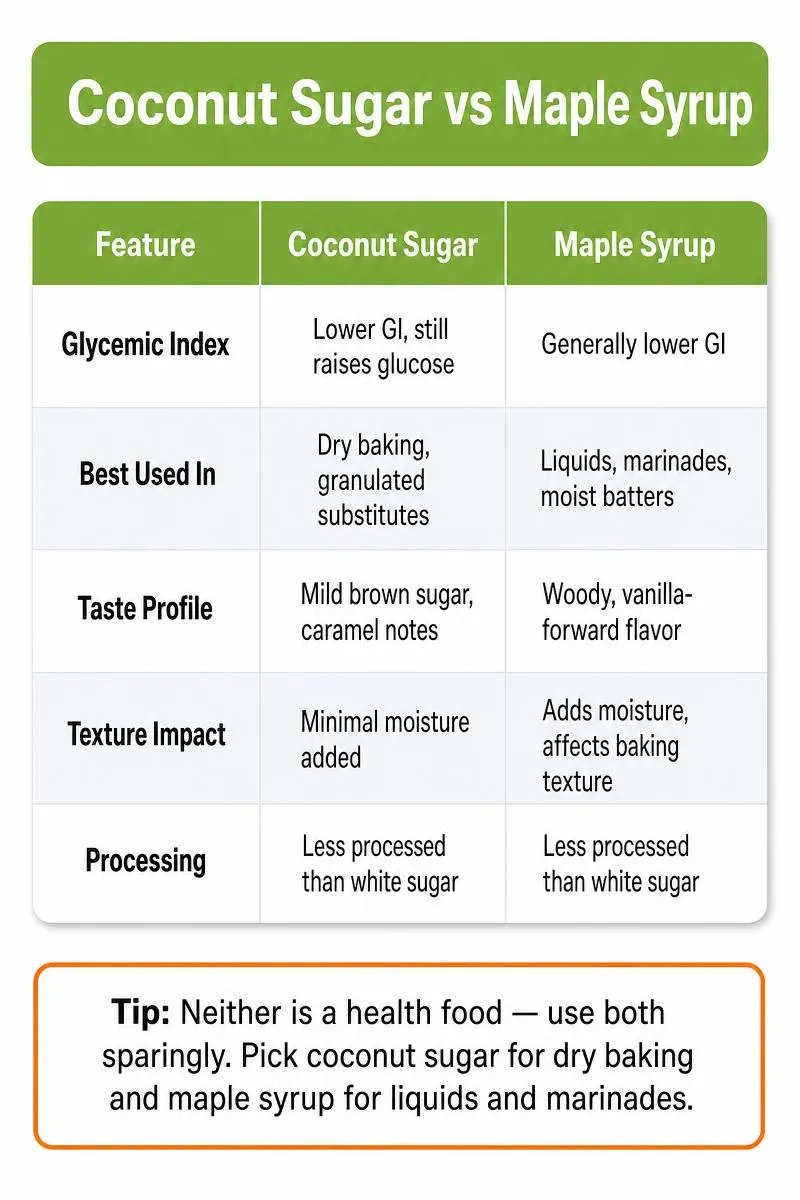
Coconut Sugar Vs Maple Syrup Quick Comparison
| Feature | Coconut Sugar | Maple Syrup |
|---|---|---|
| Glycemic Index | Lower GI, still raises glucose | Generally lower GI |
| Best Used In | Dry baking, granulated substitutes | Liquids, marinades, moist batters |
| Taste Profile | Mild brown sugar, caramel notes | Woody, vanilla-forward flavor |
| Texture Impact | Minimal moisture added | Adds moisture, affects baking texture |
| Processing | Less processed than white sugar | Less processed than white sugar |
What Is Coconut Sugar?
Coconut sugar comes from the sap of coconut palm flower buds. Harvesters cut into the flower buds, collect the liquid sap, then heat it until the water evaporates and the remaining solids granulate. The evaporation and crystallization process skips bleaching, bone char filtering, and molasses separation – the sap heats, thickens, and dries.
Coconut sugar works best in dry baking, coffee, and any recipe where you’d normally reach for brown sugar. The granulated texture means you can swap it one-to-one in most recipes that call for brown sugar without adjusting other ingredients.
Strengths: Coconut sugar has a texture nearly identical to brown sugar, a mild caramel flavor that doesn’t dominate, and an easy substitution ratio that makes swapping straightforward.
Weaknesses: Coconut sugar clumps in storage if exposed to humidity, still contains a high sugar content comparable to regular sugar, and carries a premium price point compared to refined sugar.
Worth Reading Next
Side-by-side comparison of coconut sugar and date sugar covering sweetness, flavor, and substitution tips for baking.
What Is Maple Syrup?
Maple syrup starts as sap from maple trees – primarily sugar maples. Producers boil the sap down until enough water evaporates to concentrate the sugars, then grade the finished syrup by color and flavor intensity.
Darker grades carry stronger, more robust flavor; lighter grades taste more delicate. Maple syrup works well on pancakes, in beverages, glazes, dressings, marinades, and wet batters.
Because it’s already a liquid, maple syrup dissolves easily into other liquids without needing heat or vigorous stirring.
Strengths: Maple syrup offers a distinct, recognizable flavor, dissolves readily in cold and warm liquids, and is widely available with clear grading standards that help you predict what you’re buying.
Weaknesses: Maple syrup adds moisture to recipes, which can throw off baking ratios if not accounted for. The strong flavor can overpower delicate dishes, and pure maple syrup costs more than commercial pancake syrup.
Coconut Sugar vs Maple Syrup: Nutrition and Glycemic Impact
Both sweeteners are still primarily sucrose. Coconut sugar and maple syrup have similar calorie density, and neither offers a meaningful reduction in sugar intake compared to white sugar. If you’re trying to cut total sugar, swapping one for the other won’t get you there.
Maple syrup generally has a lower glycemic index than coconut sugar. A lower glycemic index means glucose enters the bloodstream more gradually, which may reduce sharp blood sugar spikes. Some sources suggest coconut sugar’s glycemic index sits lower than white sugar.
For people managing diabetes, portion control matters more than which sweetener you choose. Both raise blood glucose, and neither is safe to consume freely. Consult a healthcare provider for personalized guidance.
Both sweeteners contain trace nutrients. Some sources suggest coconut sugar retains small amounts of potassium, magnesium, and zinc, along with inulin – a fiber that may slow how fast sugar hits your bloodstream. Maple syrup contains small amounts of trace minerals.
The quantities in both are modest enough that you’d need to eat large amounts to get a meaningful dose – which defeats the purpose of using sweetener sparingly.
Coconut Sugar vs Maple Syrup: Taste and Texture
Coconut sugar tastes like mild brown sugar with caramel and molasses notes. It’s slightly less sweet than white sugar, which means baked goods made with coconut sugar carry a gentler sweetness rather than a sugary punch. The flavor blends into recipes rather than announcing itself.
Maple syrup tastes woody, vanilla-forward, and toasty with toffee undertones. The flavor varies by grade – darker syrup delivers more intensity, lighter syrup stays more subtle. Maple syrup’s flavor is distinctive enough that it becomes part of the dish’s identity, not just its sweetness.
The physical forms differ significantly. Coconut sugar is dry granules; maple syrup is a viscous liquid.
Dry granules blend into doughs and batters without adding moisture, keeping textures crisp and crumbly. Liquid maple syrup coats ingredients, adds body to liquids, and changes the moisture balance of anything you bake with it.
Explore More
Explains flavor differences and practical swap proportions when replacing brown sugar with coconut sugar in recipes.
Coconut Sugar vs Maple Syrup: Baking and Cooking Performance
Coconut sugar wins for cookies, muffins, and dry baking where granulated structure matters. Because it behaves like brown sugar, coconut sugar creaming with butter works the same way, and the dry granules maintain the structural integrity that baked goods depend on.
Maple syrup wins for sauces, glazes, and beverages where liquid integration matters. Maple syrup dissolves instantly into liquids, making it ideal for salad dressings, marinades, and beverages where you want sweetness without grit. No heating or dissolving step needed.
Substituting one for the other requires adjustments. If you replace coconut sugar with maple syrup in a baking recipe, you’re adding liquid – so reduce other liquids in the recipe by a few tablespoons and sometimes increase the leavening agent slightly to compensate. If you replace maple syrup with coconut sugar in a liquid recipe, you may need to add liquid to make up for the lost moisture.
Which Should You Choose?
If you bake cookies, cakes, or bread where dry sugar is required, choose coconut sugar. The granulated texture integrates into doughs and batters without throwing off moisture ratios.
If you make glazes, marinades, pancakes, or beverages, choose maple syrup. The liquid form dissolves instantly and adds flavor that complements savory and sweet applications.
If you monitor blood sugar closely, maple syrup may be the better option due to its lower glycemic index. Consult a healthcare provider for personalized guidance.
If you want the closest flavor to brown sugar or caramel, choose coconut sugar. The mild, molasses-like taste mimics brown sugar without overpowering other ingredients.
If you prefer a distinct, robust sweetness for oatmeal and breakfast foods, choose maple syrup. The woody, vanilla-forward flavor stands on its own.
FAQs About Coconut Sugar and Maple Syrup
What are the downsides of coconut sugar?
Coconut sugar clumps in storage when exposed to moisture, costs more than refined sugar, and still contains high sugar content comparable to regular sugar. It’s not a low-glycemic free pass.
Is coconut sugar or maple syrup the healthier choice?
Neither is a health food. Both are primarily sucrose and raise blood glucose. Maple syrup has a lower glycemic index, and coconut sugar retains small amounts of inulin and potassium, magnesium, and zinc – but the differences are modest. Use whichever fits your recipe and keep portions small.
Is coconut sugar anti-inflammatory?
No strong evidence supports coconut sugar as anti-inflammatory. Coconut sugar contains trace minerals and inulin, but the quantities are too small to attribute anti-inflammatory effects. Don’t rely on it for that purpose.
Can diabetics safely use coconut sugar or maple syrup?
Both raise blood glucose and require portion control. Maple syrup’s lower glycemic index may cause a more gradual rise, but neither is safe to consume freely. A healthcare provider can give guidance based on your specific situation.
Which has a lower glycemic index, coconut sugar or maple syrup?
Maple syrup generally has a lower glycemic index than coconut sugar in most comparisons. Both still raise blood glucose, but maple syrup tends to cause a more gradual increase.
Do coconut sugar and maple syrup taste different?
Yes, noticeably. Coconut sugar tastes like mild brown sugar with caramel and molasses notes. Maple syrup tastes woody, vanilla-forward, and toasty. The flavors are distinct enough that swapping one for the other changes the character of a dish.
Which is better for baking, coconut sugar or maple syrup?
Coconut sugar is better for most baking. The dry granulated texture integrates into doughs and batters without adding moisture, and it substitutes for brown sugar easily. Maple syrup works better in wet batters, glazes, and liquid-based recipes.
Can you substitute coconut sugar for maple syrup in recipes?
Yes, but you’ll need to adjust for moisture. Coconut sugar is dry, so replacing maple syrup means adding liquid elsewhere in the recipe – a few tablespoons of water, milk, or oil depending on what the recipe calls for. Flavor will also shift from maple to caramel.
Are coconut sugar and maple syrup less processed than white sugar?
Yes. Coconut sugar skips bleaching, bone char filtering, and molasses separation. Maple syrup is boiled tree sap with no additives in its pure form. Both are less processed than white sugar, though both still concentrate sugar significantly.
Also Worth Checking Out
Compares calorie, sweetness, and baking implications between coconut sugar and the sweetener stevia.
Final Thoughts
Neither sweetener is a health food, but each has clear advantages depending on the use case. Maple syrup’s lower glycemic index may suit people managing blood sugar, while coconut sugar’s granulated texture makes it the go-to for bakers who need dry structure.
Test both in your favorite recipe and taste the difference for yourself.
External References