Desiccated Coconut or Coconut Flakes: Which to Use?
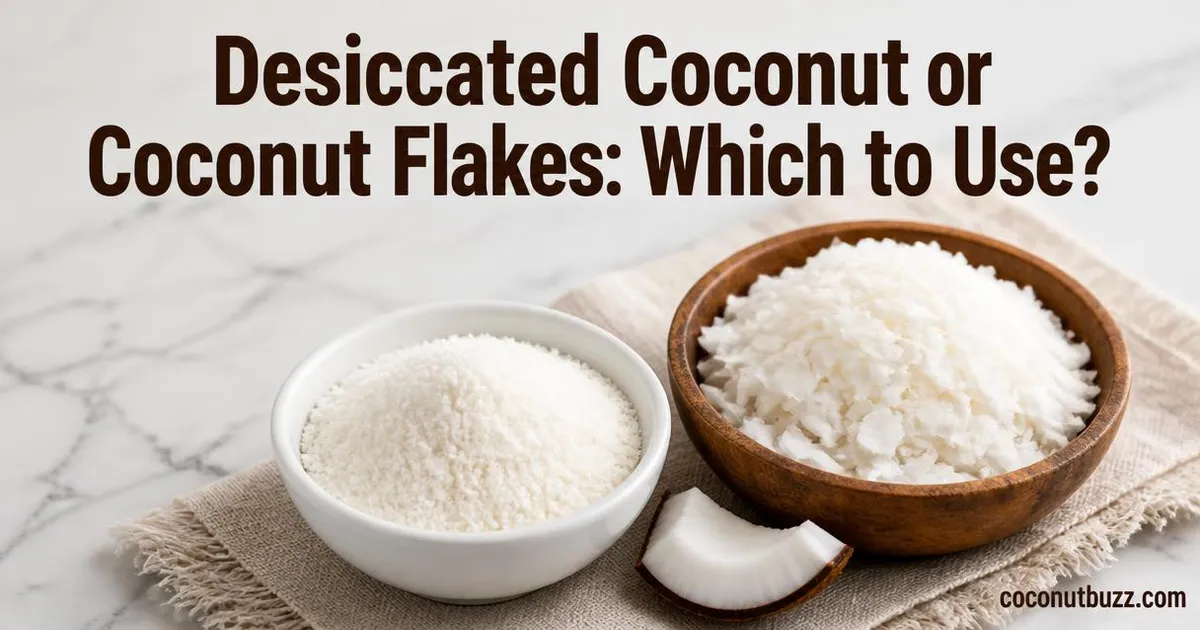
Standing in the baking aisle, you’ll find desiccated coconut and coconut flakes side by side, and they look similar enough that grabbing the wrong one is an easy mistake. Both are dried coconut meat, and both bring coconut flavor to whatever you’re making. But they behave differently once they hit your batter, dough, or topping.
The decision comes down to four things: texture, moisture, sweetness, and whether one can actually stand in for the other. Neither one is universally better. The right pick depends entirely on what you’re cooking.
Key Takeaways
- Desiccated coconut is finely grated and very dry; coconut flakes are larger, flatter pieces that keep their visible structure.
- Both deliver coconut flavor, but the gap in size and moisture changes how each one feels in baked goods and toppings.
- Desiccated coconut is almost always unsweetened; coconut flakes come in both sweetened and unsweetened varieties.
- Substituting one for the other shifts the final texture and appearance of your dish, sometimes noticeably.
- Store both in airtight containers in a cool, dry place; refrigeration extends freshness once opened.
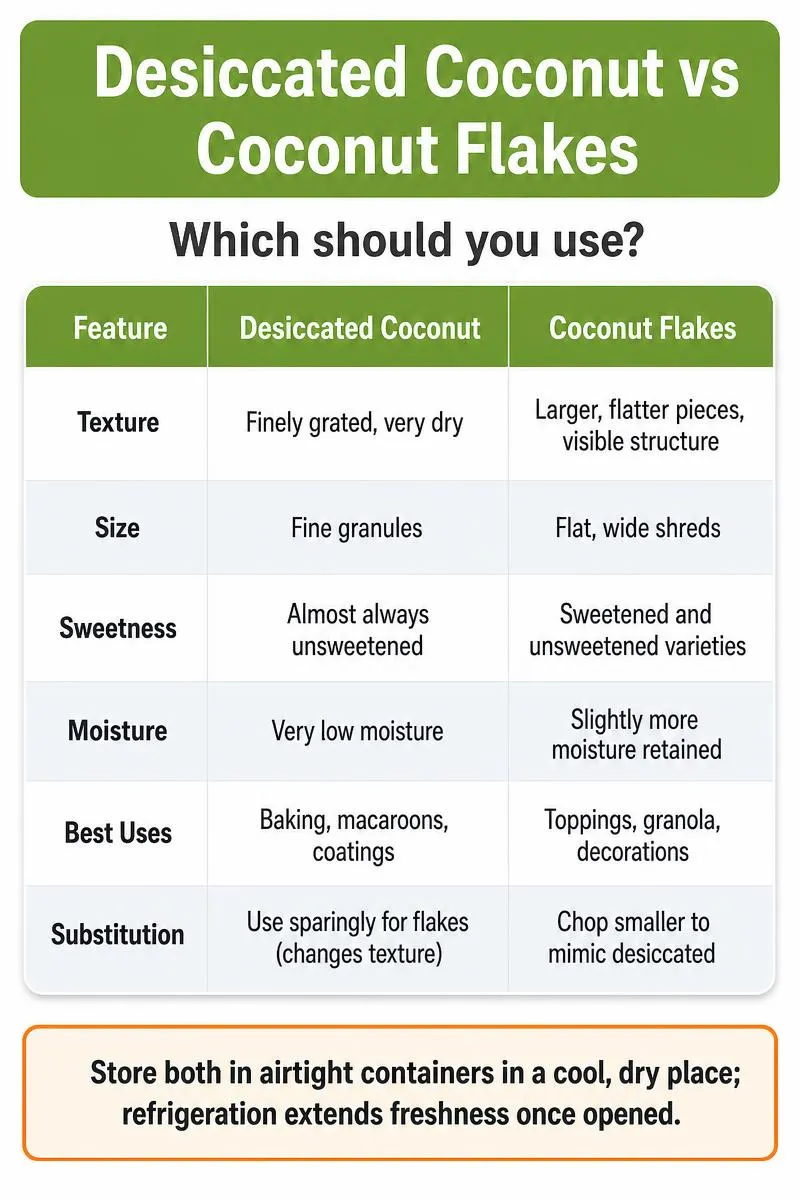
Desiccated Coconut Vs Coconut Flakes Quick Comparison
| Feature | Desiccated Coconut | Coconut Flakes |
|---|---|---|
| Texture | Finely grated, very dry | Larger, flatter pieces |
| Size | Fine granules | Flat, wide shreds |
| Sweetness | Almost always unsweetened | Sweetened & unsweetened |
| Moisture | Very low moisture | Slightly more moisture |
| Best Uses | Baking, macaroons, coatings | Toppings, granola, decorations |
| Substitution | Use sparingly for flakes | Chop smaller to mimic desiccated |
What Is Desiccated Coconut?
Desiccated coconut is coconut meat that has been finely grated and dried until most of the moisture is gone. The result is a powdery, fine-grain product that feels almost like dry sand between your fingers. It disperses evenly through batters and coatings without clumping, and it absorbs liquid well.
Best uses: macaroons, cakes, curries, energy balls, and fine breading. In each of these, you want coconut flavor and moisture absorption without large pieces interrupting the texture.
Strengths of desiccated: distributes evenly, absorbs liquid without clumping, and is reliably unsweetened. If a recipe calls for unsweetened coconut and you grab sweetened flakes instead, the sugar balance shifts.
Weaknesses of desiccated: desiccated coconut can disappear in recipes where coconut texture is the whole point. A topping that’s supposed to show visible coconut strands will look flat and plain. On its own, it’s also quite dry. Eating a spoonful is more like eating flour than eating a snack.
Keep Reading
Young coconut vs mature coconut
Explains how coconut maturity changes texture and moisture – useful when deciding between flakes and desiccated forms.
What Is Coconut Flakes?
Coconut flakes are wider, flatter pieces of dried coconut meat. They’re bigger than shredded coconut and visibly distinct. They hold their shape in most recipes, which means they stay visible in the finished dish and add a chewy bite that desiccated coconut can’t replicate.
Best uses: toppings for granola, smoothie bowls, cookies, and trail mix. Flakes also toast well, which brings out a nutty flavor and golden color that works as a garnish.
Strengths of flakes: adds visual appeal and a satisfying chew. If you want someone to see and feel the coconut in every bite, flakes do that job.
Weaknesses of flakes: flakes don’t integrate smoothly into fine batters. They sit in the dough as distinct pieces, which can be wrong for a smooth cake or a uniform coating. Sweetened versions also add sugar, which changes the sweetness level of your recipe whether you intended it or not.
Desiccated Coconut vs Coconut Flakes: Texture and Size
Texture is where these two diverge most clearly. Desiccated coconut is powdery to fine-grain, while flakes are wide, visible strips that you can pick up individually. That size gap changes how each one behaves once mixed into something.
In a batter or dough, desiccated coconut blends in and disappears. It absorbs moisture from the surrounding mixture and becomes part of the structure rather than a distinct element. Flakes stay as separate pieces, creating pockets of chew throughout.
In coatings and breading, desiccated coconut creates a fine, even crust. Flakes produce a chunky, uneven coating that looks rustic but won’t adhere as uniformly.
Neither form wins overall. Use desiccated when the coconut should disappear into the recipe, and reach for flakes when it should stand out.
Desiccated Coconut vs Coconut Flakes: Taste and Sweetness
When both are unsweetened, the coconut flavor is similar. Both come from the same dried coconut meat, and the drying process concentrates the same medium-chain fatty acids. The difference in taste between unsweetened desiccated and unsweetened flakes is minimal.
The real split comes with added sugar. Sweetened coconut flakes are common on store shelves. They’re coated with sugar, which changes both flavor and calorie content. Desiccated coconut is almost always sold unsweetened, so what you taste is coconut, not sugar.
Winner: desiccated coconut, if you want pure coconut flavor without added sugar. When both are unsweetened, they’re comparable.
Also Worth Checking Out
Sweetened vs unsweetened coconut
Breaks down how added sugar affects taste and baking performance – directly relevant to the article’s taste and…
Desiccated Coconut vs Coconut Flakes: Nutrition
Both products are dried coconut, so the base nutrition is similar by weight. You’re getting the same lauric acid, the same medium-chain fatty acids, and the same dietary fiber in either form.
Sweetened flakes change the picture. The added sugar increases the calorie content and carbohydrate count per serving. If you’re comparing unsweetened flakes to desiccated, the numbers are close.
Density also matters. A cup of desiccated coconut packs more actual coconut meat than a cup of flakes, because the fine grains settle together with less air between them. If a recipe measures by volume rather than weight, you’re getting more coconut and more fat, fiber, and calories from the desiccated version.
Winner: desiccated coconut, if you’re avoiding added sugar. By weight, the two are roughly comparable when both are unsweetened.
Desiccated Coconut vs Coconut Flakes: Best Uses and Substitutions
Matching the form to the recipe is the simplest way to get the result you want. Desiccated coconut works better when fine texture and absorption matter. Think cake batter, cookie dough, curry bases, and energy ball mixtures. Flakes excel as toppings and in recipes where chew is part of the appeal, like granola or trail mix.
Can you substitute one for the other? Partially. Flakes can be pulsed in a food processor to approximate desiccated coconut. The smaller pieces will behave more like the fine grain in batters and coatings. The reverse doesn’t work. You can’t take desiccated coconut and turn it into flakes; the structure is already gone.
Winner: neither. Match the form to the recipe, or accept that the texture will change.
Which Should You Choose?
- Disappear into batter: Desiccated coconut. It blends in without leaving visible pieces.
- Chewy topping: Coconut flakes. The size and chew are what you’re after.
- Avoiding added sugar: Desiccated coconut. It’s almost always sold without added sugar.
- Visible coconut: Coconut flakes. They hold their shape and stay visible.
- Only have flakes: Pulse them in a food processor until fine.
You Might Also Like
Covers how coconut-based flours behave in recipes and substitutions – helpful for readers exploring baking swaps with…
FAQs About Desiccated Coconut and Coconut Flakes
Can I substitute coconut flakes for desiccated coconut, or turn flakes into desiccated?
Yes, with a food processor. Pulse unsweetened flakes until they reach a fine, powdery consistency. The texture won’t be identical, but it works in most recipes that call for desiccated coconut.
What is desiccated coconut called in the US?
It’s usually labeled “desiccated coconut” or “fine coconut.” Some brands call it “coconut flour” on the packaging, but true coconut flour is different. It’s made from defatted coconut meat after the oil is pressed out.
Is desiccated coconut the same as unsweetened shredded coconut?
No. Shredded coconut has longer, thread-like strands, while desiccated coconut is finely grated into a powdery texture. Both are typically unsweetened, but the size and texture differ.
Can you eat uncooked desiccated coconut?
Yes. It’s already dried and ready to eat. It’s quite dry on its own, so most people prefer it mixed into recipes rather than eaten plain.
Why is dry coconut sometimes restricted on flights?
Some countries restrict whole dry coconuts (not packaged desiccated or flakes) because the husk can harbor pests or insects. Packaged, processed coconut products generally aren’t affected.
How should I store dried coconut?
Keep both desiccated coconut and flakes in airtight containers in a cool, dry place. Refrigeration extends freshness after opening, and freezing works for longer storage.
Which is healthier, desiccated coconut or coconut flakes?
By weight, they’re nutritionally similar when both are unsweetened. Sweetened flakes add sugar and calories. Desiccated coconut is denser per cup, so volume measurements give you more coconut and more of everything that comes with it.
Should I choose sweetened or unsweetened coconut flakes?
Unsweetened, unless your recipe specifically calls for sweetened. You can always add sugar yourself, but you can’t remove it from sweetened flakes. Unsweetened gives you control over the sweetness level.
Final Thoughts
There’s no universal winner here. The right choice depends on what your recipe needs and what texture you’re after.
If you only stock one, desiccated coconut is more versatile in baking. It works in cakes, cookies, curries, and coatings where flakes would be too chunky. But it can’t replicate the visual appeal and chew of a flake topping.
If you’re substituting flakes for desiccated in a pinch, choose an unsweetened variety to keep the flavor and sugar balanced.
External References
- Dietary fiber: Essential for a healthy diet – Mayo Clinic
- 7 Science-Based Benefits of MCT Oil – Healthline
- Coconut Oil – The Nutrition Source – Harvard Health
- Biomedical Applications of Lauric Acid: A Narrative Review – NIH
- Understand the Nutrition Value of Coconut Flakes – Globalresourcesdirect
- Coconut Flakes: Calories, Nutrition and Health Benefits – Nutriscan