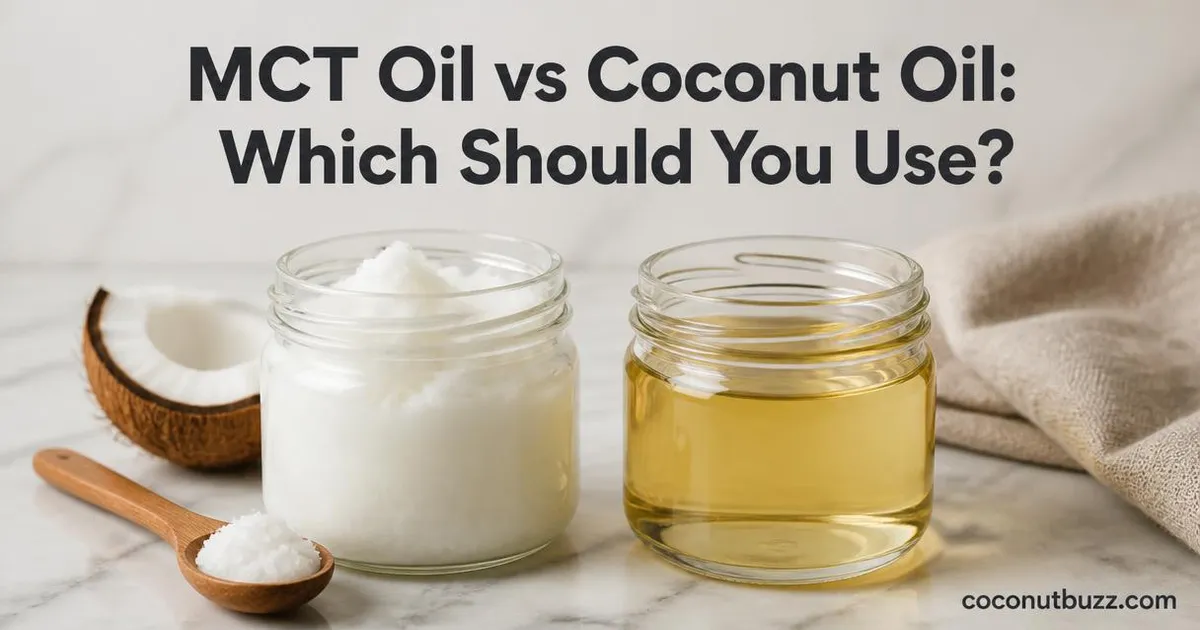
MCT Oil vs Coconut Oil: Which Should You Use?
Both MCT oil and coconut oil come from the same coconut, but one is a concentrated extract while the other is the whole-food version. MCT oil is a concentrated extract – manufacturers extract and concentrate the medium-chain triglycerides from coconut oil. Coconut oil is the whole-food version, with a broader mix of fatty acids that gives it different properties.
The choice between them comes down to what you’re trying to do. If you want rapid energy and ketone production, MCT oil gets you there faster. If you want a versatile oil for cooking, baking, and skincare, coconut oil covers more ground for less money.
Key Takeaways
- MCT oil is a purified extraction from coconut oil, concentrated in caprylic acid (C8) and capric acid (C10), while coconut oil contains those plus longer-chain fats
- MCT oil produces ketones faster and may support weight loss more directly, but coconut oil offers cooking stability and skincare benefits
- Coconut oil handles high heat better and works as a topical moisturizer, while MCT oil is preferred for coffee, smoothies, and ketogenic diets
- MCT oil can cause digestive discomfort if you start with too much, while coconut oil is generally gentler on the stomach
- Your choice depends on priority: metabolic effects or versatility across cooking and personal care
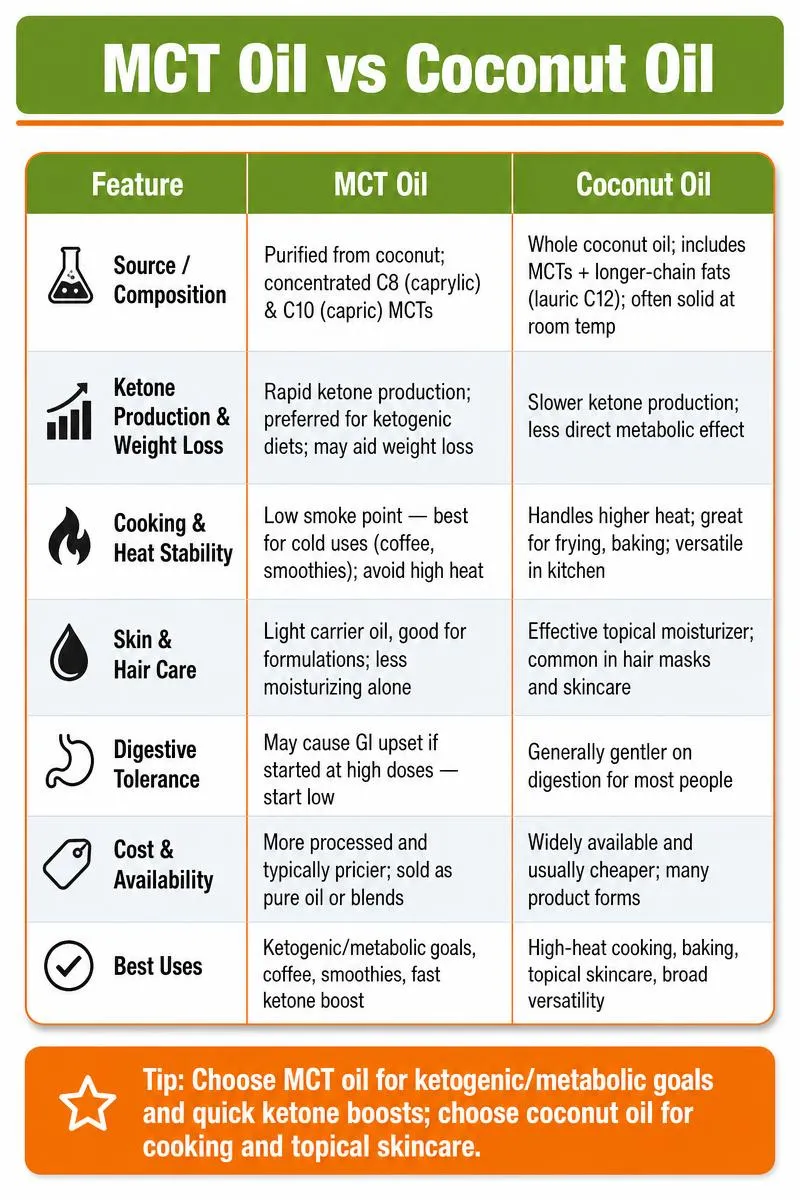
Mct Oil Vs Coconut Oil Quick Comparison
| Feature | MCT Oil | Coconut Oil |
|---|---|---|
| Source / Composition | Purified from coconut; concentrated C8 (caprylic) & C10 (capric) MCTs | Whole coconut oil; includes MCTs + longer-chain fats (lauric C12); often solid at room temp |
| Ketone Production & Weight Loss | Rapid ketone production; preferred for ketogenic diets; may aid weight loss | Slower ketone production; less direct metabolic effect |
| Cooking & Heat Stability | Low smoke point — best for cold uses (coffee, smoothies); avoid high heat | Handles higher heat; great for frying, baking; versatile in kitchen |
| Skin & Hair Care | Light carrier oil, good for formulations; less moisturizing alone | Effective topical moisturizer; common in hair masks and skincare |
| Digestive Tolerance | May cause GI upset if started at high doses — start low | Generally gentler on digestion for most people |
| Cost & Availability | More processed and typically pricier; sold as pure oil or blends | Widely available and usually cheaper; many product forms |
| Best Uses | Ketogenic/metabolic goals, coffee, smoothies, fast ketone boost | High-heat cooking, baking, topical skincare, broad versatility |
What Is MCT Oil?
MCT oil is a concentrated oil extracted from coconut oil (or palm kernel oil) containing medium-chain triglycerides – primarily caprylic acid (C8) and capric acid (C10). Manufacturers make MCT oil from coconut oil through a process called fractionation, which removes longer-chain fatty acids and isolates the MCTs.
The main strength of MCT oil is rapid absorption. Your body converts C8 and C10 into ketones quickly because these fatty acids go straight to the liver without needing bile salts for digestion. MCT oil also has no coconut flavor and stays liquid at all temperatures, which makes it easy to add to drinks.
Best uses for MCT oil include adding it to coffee or smoothies, supporting ketogenic diets, and getting quick energy without cooking. MCT oil has a low smoke point and isn’t suited for high-heat cooking. Taking too much too quickly can cause digestive upset.
MCT oil also costs more than coconut oil due to the extra processing.
A side-by-side comparison of beef tallow and coconut oil for everyday cooking and heat stability.
What Is Coconut Oil?
Coconut oil is pressed from coconut meat and contains more than half medium-chain fatty acids, along with longer-chain fats like lauric acid. The oil is available as refined or unrefined (virgin), and the two versions have different flavor profiles and smoke points.
Refined coconut oil has a higher smoke point and a neutral flavor, making it better for cooking where you don’t want a coconut taste. Unrefined (virgin) coconut oil retains a distinct coconut flavor and has a slightly lower smoke point but keeps more of the coconut’s natural flavor and aroma compounds.
Best uses for coconut oil include cooking at medium to high heat, baking, oil pulling, and moisturizing skin and hair. The main limitation is that coconut oil converts to ketones more slowly than MCT oil because it contains longer-chain fats alongside the MCTs. Some sources also suggest that coconut oil may raise LDL cholesterol in certain individuals due to its saturated fat content.
MCT Oil vs Coconut Oil: Ketone Production and Weight Loss
MCT oil converts to ketones faster than coconut oil because it contains a higher concentration of C8 and C10 fatty acids. These specific medium-chain triglycerides travel directly to the liver, where they’re converted into ketone bodies efficiently.
Coconut oil provides some MCTs, but it also contains longer-chain fats that don’t produce ketones as efficiently. Lauric acid – the most abundant fatty acid in coconut oil – behaves more like a long-chain fat in terms of how your body processes it.
MCT oil wins for anyone focused on ketosis or weight loss through metabolic effects. If your goal is maintaining a ketogenic state or producing ketones quickly, MCT oil gets you there with less oil overall.
MCT Oil vs Coconut Oil: Cooking and Heat Stability
Coconut oil has a higher smoke point than MCT oil and holds up better under heat. Refined coconut oil can handle higher temperatures than unrefined, but both versions outperform MCT oil for cooking.
MCT oil has a lower smoke point and is not recommended for high-heat cooking. Heating MCT oil beyond its smoke point degrades the oil and produces off-flavors and breakdown products.
Coconut oil adds flavor to dishes – which can be a pro or a con depending on what you’re making. MCT oil is flavorless, so it works better added to finished foods or drinks where you don’t want to change the taste.
Coconut oil wins for cooking and baking. MCT oil is better added to coffee, smoothies, or other foods after they’re prepared.
Keep Reading
How coconut milk compares to regular milk for cooking and nutrition, useful when substituting coconut products in…
MCT Oil vs Coconut Oil: Skin and Hair Care
Coconut oil has a long history of topical use for moisturizing skin and conditioning hair. The longer-chain fatty acids in coconut oil, particularly lauric acid, provide barrier protection on the skin and may have antimicrobial properties.
MCT oil is lighter and less occlusive than coconut oil. MCT oil absorbs faster into the skin, but that faster absorption means it offers less moisture retention over time. Coconut oil sits on the surface longer, trapping moisture beneath it.
Coconut oil wins for beauty and skincare applications. If you’re looking for a single product that works as a moisturizer, hair conditioner, or massage oil, coconut oil does more.
MCT Oil vs Coconut Oil: Digestive Tolerance
MCT oil can cause digestive discomfort, cramping, or diarrhea if you take too much too quickly. The rapid absorption that makes MCT oil metabolically useful also means your digestive system has to handle a sudden influx of fatty acids.
Coconut oil is gentler on the stomach because its mix of fatty acid lengths slows the absorption process. The longer-chain fats in coconut oil digest at a more moderate pace.
Both oils should be started in small amounts if you’re new to them, but MCT oil requires more caution. Coconut oil wins for those with sensitive digestion.
MCT Oil vs Coconut Oil: Cost and Availability
Coconut oil is widely available and less expensive because it requires less processing. You can find coconut oil in almost any grocery store at a lower price point than MCT oil.
MCT oil costs more due to the fractionation process needed to extract and concentrate the medium-chain triglycerides. The extra processing steps add to the price.
Coconut oil also offers more uses per dollar if you cook with it and use it topically. One jar covers cooking, baking, skincare, and haircare. MCT oil is more specialized – you’re paying for concentration, not versatility.
Coconut oil wins for budget-conscious buyers who want a multi-purpose product.
Keep Reading
A practical comparison of coconut oil and Vaseline for skin and topical uses and when to choose each.
Which Should You Choose?
Choose MCT oil if you follow a ketogenic diet, want to add fat to coffee without flavor, or are specifically targeting weight loss through ketone production. MCT oil gives you faster energy without the longer-chain fats, but start with a small amount and increase gradually to avoid digestive issues.
Choose coconut oil if you need a cooking oil for medium to high heat, want one product for both kitchen and bathroom, or prefer a whole-food option. Coconut oil also works better for topical use on skin, hair, or for oil pulling.
You can use both. Coconut oil handles cooking and beauty needs, while MCT oil supports metabolic and energy goals. Many people keep both on hand for different purposes.
FAQs About MCT Oil and Coconut Oil
Is coconut oil the same as MCT oil?
No. Coconut oil contains MCTs along with longer-chain fatty acids, while MCT oil is a concentrated extract containing primarily C8 and C10 MCTs with the other fats removed.
Can I use coconut oil in my coffee instead of MCT oil?
Yes, but it won’t produce ketones as quickly, may solidify when it hits the hot liquid, and will add a coconut flavor. MCT oil stays liquid and is flavorless, which makes MCT oil the more practical choice for coffee.
What is the downside of MCT oil?
MCT oil can cause digestive issues like cramping, diarrhea, or nausea if you take too much too soon. MCT oil is also not suitable for high-heat cooking and costs more than coconut oil.
Why do cardiologists say to avoid coconut oil?
Coconut oil is high in saturated fat, and some research suggests it may raise LDL cholesterol in certain people. The concern is specific to cardiovascular risk – not all uses of coconut oil.
What happens if you take a spoonful of coconut oil every day?
You’ll add a concentrated dose of saturated fat – roughly a tablespoon of oil – to your daily intake. Some people report improved energy, but effects vary and depend on your overall diet and health status.
Why do I feel weird after taking MCT oil?
MCT oil is absorbed rapidly and can cause a quick energy spike, digestive upset, or nausea if you’re not used to the amount you took. Start with a small amount and build up over time.
Is MCT oil antifungal?
MCT oil may have some antimicrobial properties, particularly from caprylic acid (C8), but research on its antifungal effectiveness is limited compared to whole coconut oil, which contains lauric acid – a compound with more established antimicrobial activity.
What should you not mix with MCT oil?
Avoid taking large amounts on an empty stomach or mixing MCT oil with other high-fat foods if you’re new to it. Both increase the risk of digestive discomfort.
Final Verdict
If your goal is ketone production, weight loss support, or adding fat to drinks without flavor, MCT oil is the better choice. If you want a versatile oil that works in the kitchen, bathroom, and on your skin, coconut oil offers more uses for less money. Figure out your primary use first – metabolic support or everyday versatility – then pick the one that fits.
External References