Coconut Oil vs Vegetable Oil: Which Is Better?
Walk into any kitchen and you’ll find a bottle of vegetable oil on the shelf – and maybe a jar of coconut oil sitting nearby. They’re two of the most common cooking oils, but they behave differently enough that swapping one for the other actually changes your food.
Coconut oil is solid at room temperature, carries a noticeable coconut flavor, and gets flagged by cardiologists for its saturated fat content. Vegetable oil stays liquid, tastes neutral, and blends into almost anything without announcing itself. The choice between the two comes down to what you’re cooking, how hot your pan gets, and what you want the final dish to taste like.
Key Takeaways
- Cardiologists often warn against coconut oil because of its saturated fat content – something vegetable oil avoids by relying on polyunsaturated fats instead.
- Vegetable oil stays liquid and neutral at room temperature, which makes it more versatile for savory cooking where you don’t want added flavor.
- Coconut oil and vegetable oil usually swap 1:1 in recipes, but the flavor and texture of the finished dish shift noticeably.
- High-heat frying favors whichever oil has the higher smoke point – and refined versions of both handle more heat than their unrefined counterparts.
- The better choice depends on the recipe and your overall diet, not on one being universally healthier.
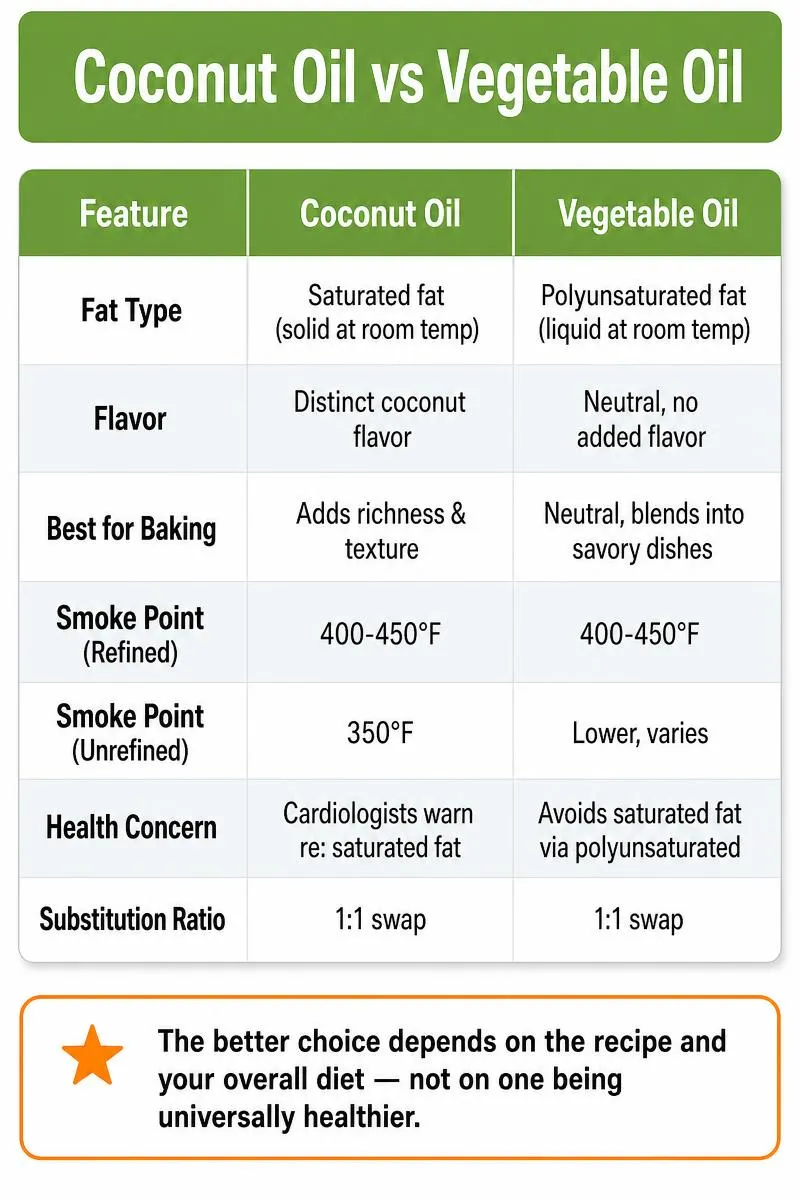
Quick Comparison: Coconut Oil Vs Vegetable Oil
| Feature | Coconut Oil | Vegetable Oil |
|---|---|---|
| Fat type | Saturated fat (solid at room temp) | Polyunsaturated fat (liquid at room temp) |
| Flavor | Distinct coconut flavor | Neutral, no added flavor |
| Best for baking | Adds richness & texture | Neutral; blends into savory dishes |
| Smoke point (refined) | 400–450°F | 400–450°F |
| Smoke point (unrefined) | ~350°F | Lower; varies |
| Health concern | Higher saturated fat; cardiologists warn | Higher polyunsaturated; avoids saturated fat |
| Substitution ratio | 1:1 swap | 1:1 swap |
What Is Coconut Oil?
Coconut oil comes from the meat of mature coconuts. Producers press or extract the fat from dried coconut kernel, and the resulting oil is solid at cooler room temperatures. That solid texture comes from its fat profile, which is dominated by saturated fats rather than the unsaturated fats found in most liquid oils.
Unrefined coconut oil keeps a distinct coconut flavor and aroma. That makes it a natural fit for tropical cuisines, certain baked goods, and dishes where a coconut note actually belongs. Refined coconut oil goes through processing that strips most of the flavor, leaving a more neutral fat that still behaves like coconut oil chemically.
Strengths: Coconut oil is stable at high heat because saturated fats resist oxidation better than polyunsaturated fats. Refined coconut oil handles heat high enough for most stovetop cooking and roasting. The flavor can also be a plus when you want it – in cookies, granola, or Southeast Asian curries.
Weaknesses: The coconut taste limits versatility. You probably don’t want it in a savory stir-fry where coconut flavor would clash with garlic and soy sauce. Some health organizations also raise concerns about the saturated fat content, particularly lauric acid, which makes up a large portion of the fat in coconut oil.
Related Reading
Explains differences between fractionated and regular coconut oil, including properties and common uses readers may…
What Is Vegetable Oil?
When a bottle says “vegetable oil,” it’s almost always a blend of refined oils – typically soybean oil, canola oil, corn oil, or sunflower oil in some combination. The exact blend varies by brand, but the goal is the same: a neutral-tasting, liquid oil that works for almost any cooking method.
Vegetable oil stays liquid at room temperature because it’s dominated by polyunsaturated and monounsaturated fats rather than saturated fats. The refining process removes impurities, flavor compounds, and free fatty acids, which also raises the smoke point and extends shelf life.
Strengths: The neutral flavor is the biggest advantage. Vegetable oil disappears into whatever you’re cooking, which is exactly what you want for most savory dishes, boxed cake mixes, and muffins where added flavor would be a distraction. Vegetable oil is also generally affordable and widely available.
Weaknesses: The heavy refining that makes vegetable oil neutral and shelf-stable also strips away flavor compounds and antioxidants that unrefined oils retain. The polyunsaturated fat content – particularly omega-6 fatty acids like linoleic acid – is a concern from some dietary perspectives, since many people already consume far more omega-6 fats than omega-3 fats.
Coconut Oil vs Vegetable Oil: Health Impact
The health conversation around these two oils centers on fat type. Coconut oil is mostly saturated fat, and lauric acid accounts for a large chunk of that. Saturated fat raises LDL cholesterol, which is why major heart associations like the American Heart Association recommend limiting it. That’s the basis for cardiologist warnings against regular coconut oil use.
Vegetable oil, by contrast, is higher in polyunsaturated fats. These fats – including linoleic acid – tend to lower LDL cholesterol when they replace saturated fats in the diet.
Winner: This depends on your dietary context. If you’re watching saturated fat intake because of cholesterol concerns or a heart condition, vegetable oil is the safer everyday choice. If you’re less concerned about saturated fat and use oil in moderation, coconut oil isn’t automatically off the table – but vegetable oil has the broader health endorsement from major medical organizations.
Coconut Oil vs Vegetable Oil: Smoke Point and Frying
Smoke point is the temperature at which an oil starts breaking down, smoking, and producing off-flavors and potentially harmful compounds. It’s the single most important spec when you’re choosing an oil for high-heat cooking.
Refined coconut oil has a smoke point high enough for most stovetop frying, sautéing, and roasting. Unrefined coconut oil has a lower smoke point, which limits it to gentle cooking – think gentle sautéing or baking, not deep-frying.
Most vegetable oils are refined specifically for high-heat use. A typical soybean or canola blend handles higher temperatures that give more headroom for deep-frying and searing, making vegetable oil the stronger pick for anything that needs the burner cranked all the way up.
Winner: Vegetable oil wins for very high heat. Refined coconut oil is competitive for most everyday stovetop cooking, but if you’re deep-frying or searing at peak temperatures, vegetable oil gives you more margin before the oil starts breaking down.
You Might Also Like
A closer look at how coconut oil compares to olive oil for cooking, smoke point, and heart-health considerations…
Coconut Oil vs Vegetable Oil: Baking and Substitutions
Coconut oil and vegetable oil substitute for each other 1:1 in most recipes. If a recipe calls for half a cup of vegetable oil, you can use half a cup of coconut oil and the fat content will work out.
The catch is flavor and texture. Coconut oil adds a coconut taste that works beautifully in some baked goods – coconut macaroons, banana bread, certain cookies – and clashes in others. A vanilla cake made with unrefined coconut oil will taste like coconut, whether you wanted it to or not. Refined coconut oil solves this if you want the texture without the flavor.
Texture also shifts. Coconut oil is solid at room temperature, so baked goods made with it tend to be slightly firmer and denser than those made with liquid vegetable oil. Vegetable oil produces a softer, more neutral crumb that stays tender at room temperature.
Winner: Vegetable oil wins for neutral baking where you don’t want any added flavor. Coconut oil wins when the coconut flavor complements the recipe – or when you specifically want the firmer texture it produces.
Which Should You Choose?
- Deep-frying or searing at very high temperatures: Vegetable oil. Its higher smoke point gives you more margin before the oil degrades.
- Baking with zero added flavor: Vegetable oil. It disappears into cakes, muffins, and breads without leaving a taste.
- Wanting a subtle coconut taste in cookies or curries: Coconut oil. Unrefined adds the flavor; refined gives you the texture without it.
- Needing an oil that stays liquid for easy measuring and mixing: Vegetable oil. Coconut oil’s solid state means you often need to melt it before measuring.
- Concerned about saturated fat warnings from heart associations: Vegetable oil. Its polyunsaturated fat profile is more aligned with current cardiovascular health guidance.
You Might Also Like
Benefits of coconut oil pulling
Details oral-health benefits and how to do oil pulling safely, useful for readers weighing culinary uses versus other…
FAQs About Coconut Oil and Vegetable Oil
Why do cardiologists warn against coconut oil?
Coconut oil is dominated by saturated fat, and saturated fat raises LDL cholesterol. Major heart associations recommend limiting saturated fat intake, so coconut oil gets flagged despite its popularity. The warning is about the fat type, not about coconut oil being uniquely harmful.
What is the healthiest oil for cooking and heart health?
Oils high in polyunsaturated and monounsaturated fats – like canola oil, olive oil, and safflower oil – generally get the strongest recommendations for heart health. Vegetable oil blends lean in this direction. Coconut oil, being mostly saturated fat, does not.
Can I substitute coconut oil for vegetable oil in recipes?
Yes, in most cases you can swap them 1:1 by volume. Keep in mind that unrefined coconut oil adds a coconut flavor and firms up at room temperature, which changes both taste and texture. Refined coconut oil is a better swap when you want neutrality.
Is there a downside to coconut oil?
The main downside is the saturated fat content, which concerns cardiologists and anyone monitoring cholesterol. The strong coconut flavor in unrefined versions also limits which dishes it works well in.
Is coconut oil healthier than olive oil?
No, not by most nutritional standards. Olive oil is rich in monounsaturated fats – particularly oleic acid – and has decades of research supporting its cardiovascular benefits. Coconut oil’s saturated fat profile doesn’t match that evidence base.
What is the most unhealthy oil to cook with?
Oils that are partially hydrogenated contain trans fats, which are the clearest dietary risk for heart disease. These are increasingly rare due to regulation, but checking labels for “partially hydrogenated” is still worth doing. Among common cooking oils, repeatedly reused frying oil also accumulates harmful compounds.
What oil do professional chefs recommend for frying?
Professional kitchens typically use refined oils with high smoke points for frying – peanut oil, canola oil, or a vegetable oil blend. These oils handle high heat without breaking down, and they stay neutral enough that the oil doesn’t compete with the food’s flavor.
Final Verdict
Neither oil is universally better – they serve different purposes. Keep vegetable oil on hand for everyday cooking, high-heat frying, and baking where you want zero added flavor. Use coconut oil intentionally in recipes where its flavor and fat profile actually fit, rather than as a default substitute.
Try both oils in your typical frying and baking recipes this week. Taste the results side by side, and you’ll quickly see which one earns a permanent spot in your kitchen.
External References