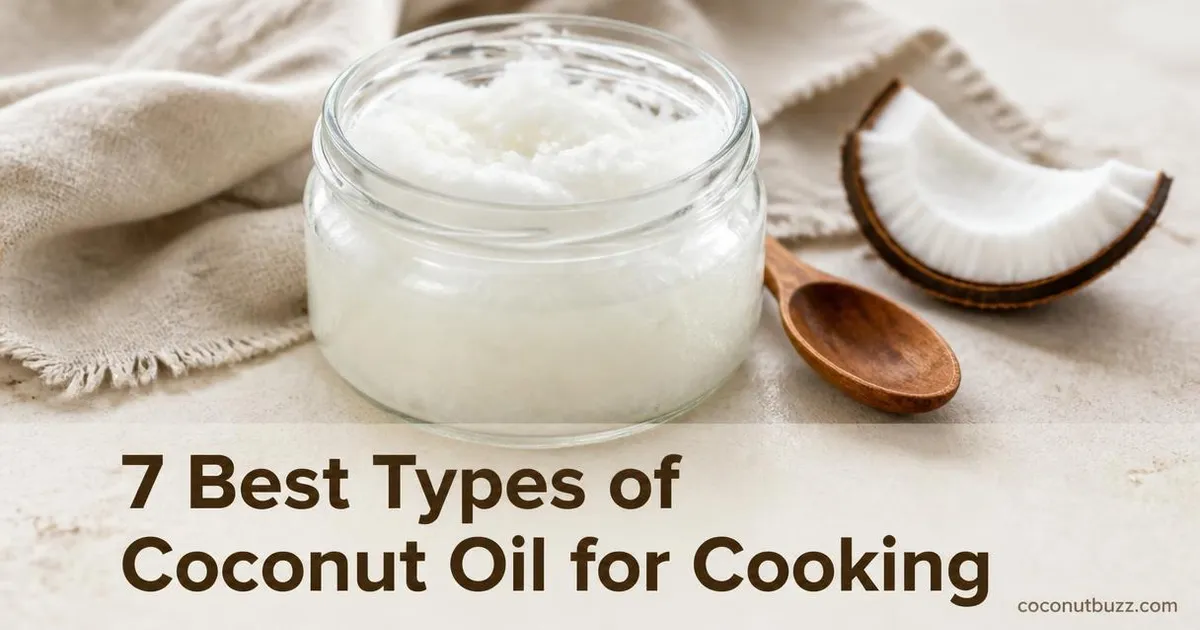
7 Best Types of Coconut Oil for Cooking
You are standing in the oil aisle looking at jars labeled refined, virgin, cold-pressed, raw, and organic. Every jar says ‘coconut oil.’ None of them tell you which one belongs in your kitchen.
Here is the honest answer: there is no single best jar. The right type depends on what you are cooking. A stir-fry wants one thing, a coconut curry wants another, and a batch of muffins wants something in between.
Below, seven types are compared by taste, processing, and best use. A few labels worth checking beyond type are covered too, because some of the most important words on a jar are not the ones in the largest font.
Key Takeaways
- Refined coconut oil tastes neutral for most everyday cooking. Unrefined virgin keeps its coconut flavor for dishes where that taste belongs.
- Extra virgin has no formal definition, so the label is not automatically better than virgin.
- Cold-pressed and raw describe how an oil was made, not a quality grade.
- Organic certification regulates farming practices, not cooking performance.
- Many kitchens keep both a refined and an unrefined jar rather than choosing one.
Worth Reading Next
A practical guide to which coconut oil varieties work best for different cooking needs and temperatures.
Comparing the Top Best Type Of Coconut Oil For Cooking
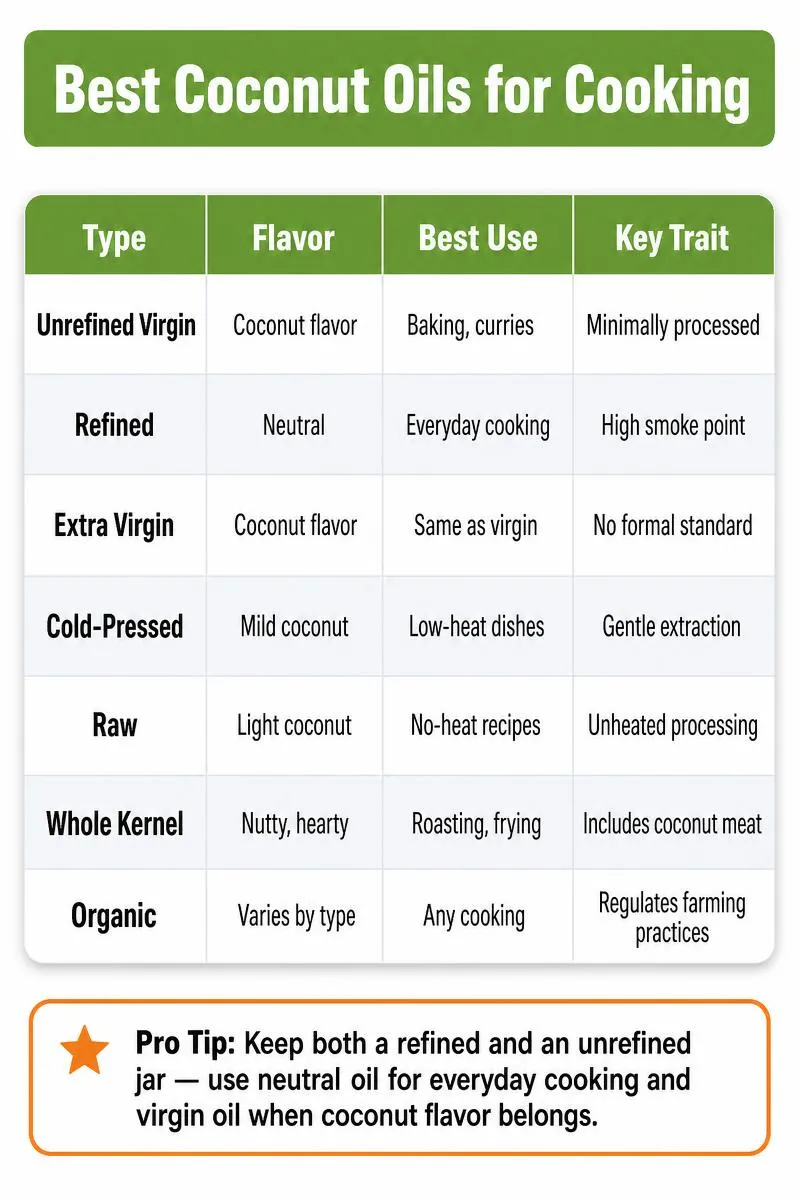
| Type | Flavor | Best Use | Key Trait |
|---|---|---|---|
| Unrefined Virgin | Coconut flavor | Baking, curries | Minimally processed |
| Refined | Neutral | Everyday cooking | High smoke point |
| Extra Virgin | Coconut flavor | Same as virgin | No formal standard |
| Cold-Pressed | Mild coconut | Low-heat dishes | Gentle extraction |
| Raw | Light coconut | No-heat recipes | Unheated processing |
| Whole Kernel | Nutty, hearty | Roasting, frying | Includes coconut meat |
| Organic | Varies by type | Any cooking | Regulates farming practices |
7 Best Types of Coconut Oil for Cooking
1. Unrefined Virgin Coconut Oil
Unrefined virgin coconut oil is the least processed jar on the shelf. The oil is extracted from fresh coconut meat, typically through mechanical pressing or centrifuge separation, without bleaching, deodorizing, or chemical refining. That skipping of bleaching and deodorizing is what keeps the coconut aroma and distinct flavor intact, carrying both into whatever you cook.
‘Unrefined’ and ‘virgin’ mean the same thing on most jars. Neither term has a single legally enforced definition, but producers use them interchangeably to signal minimal processing. If a jar says one and not the other, the oil inside is usually the same.
Unrefined virgin works best for cooks who want coconut flavor in their food and minimal processing in their pantry. Curries, tropical desserts, and certain baked goods benefit from that flavor. If you are making scrambled eggs or roasting vegetables, the coconut taste may not belong.
2. Refined Coconut Oil
Refined coconut oil goes through additional processing to remove the coconut flavor and aroma. The refining process typically involves bleaching to remove impurities and deodorizing to strip the scent. Some refined oils are processed with chemical solvents like hexane, while others use steam and mechanical methods.
What refining removes is the coconut taste. What it leaves behind is a neutral cooking fat with a smoke point higher than unrefined virgin oil. That higher smoke point suits stir-frying, sautéing, and baking where coconut flavor would interfere.
Refined coconut oil is best for cooks who dislike coconut flavor or want one all-purpose jar.
3. Extra Virgin Coconut Oil
‘Extra virgin’ is a label borrowed from olive oil, where it has a strict legal definition. Coconut oil has no equivalent standard. Any producer can put ‘extra virgin’ on a jar without meeting a specific processing requirement or quality threshold.
In practice, most jars labeled extra virgin are the same product as jars labeled virgin. The oil is extracted from fresh coconut meat with minimal processing and retains coconut flavor. The difference between the two labels is often marketing rather than processing.
Extra virgin coconut oil is best for shoppers deciding if the price jump is worth it. If a jar labeled extra virgin costs significantly more than an equivalent virgin jar with similar sourcing, the extra cost may be paying for the label rather than the oil.
4. Cold-Pressed Coconut Oil
Cold-pressed means the oil is extracted by pressing coconut meat at low temperatures. The goal is to avoid heat that could alter the oil’s composition. The pressing is mechanical, not chemical.
Expeller pressing uses higher temperatures generated by friction during the pressing itself. Solvent extraction uses chemicals like hexane to pull oil from the coconut meat. Cold-pressing avoids both the added heat and the chemical solvents.
Cold-pressed coconut oil is best for buyers who prioritize gentle processing. The label tells you about the extraction method, not about whether the oil tastes like coconut or whether it was refined afterward. A cold-pressed oil can still be refined.
5. Raw Coconut Oil
‘Raw’ on a coconut oil jar means the oil was never heated above low temperatures during production. The threshold varies by producer since, like extra virgin, raw has no single enforced standard for coconut oil.
Raw overlaps with virgin and cold-pressed in practice. A raw oil is almost always virgin, because refining requires heat. A raw oil is usually cold-pressed, since cold-pressing keeps temperatures low.
Raw coconut oil is best for minimal-processing purists who want assurance that no heat was applied at any stage. For most cooking purposes, a raw oil performs the same as a virgin cold-pressed oil.
6. Whole Kernel Coconut Oil
Whole kernel coconut oil is made from the entire coconut kernel, including the brown skin layer that sits between the white meat and the shell. Most coconut oil uses only the white kernel. Whole kernel oil keeps that brown layer in the press.
The brown layer contributes a deeper, nuttier flavor and a darker color to the finished oil. The color ranges from golden to deep amber rather than the pale or clear look of refined oil.
Whole kernel coconut oil is best for cooks wanting a stronger, traditional oil. The flavor works in dishes where a pronounced, earthy coconut taste adds depth rather than sweetness.
7. Organic Coconut Oil
Organic certification regulates how coconuts are farmed. The standards prohibit synthetic pesticides, synthetic fertilizers, and genetic modification. Certification also requires documented farming practices that support soil health and ecological balance.
What organic certification does not regulate is cooking performance. An organic coconut oil can be refined or unrefined, cold-pressed or expeller-pressed. The organic label tells you about sourcing, not about taste, smoke point, or processing method.
Organic coconut oil is best for buyers who weigh sourcing as heavily as taste and price. If pesticide use and farming practices matter to you, the organic label provides verified information about those factors. If your priority is neutral flavor, a non-organic refined oil may serve your kitchen better.
How to Choose Coconut Oil for Cooking
Beyond the seven types above, a few labels address issues that type alone does not cover. These labels deal with worker conditions, environmental impact, and contaminant safety – worth checking regardless of whether you choose refined or unrefined.
Fair Trade and Sustainably Sourced Labels
The coconut industry has documented problems with worker wages and deforestation in some regions. Fair trade certification sets minimum prices paid to producers and requires fair labor standards. Sustainably sourced labels address environmental practices, including whether coconut farming contributes to deforestation.
If you want your purchase to support better labor conditions and environmental practices, fair trade and sustainability certifications provide third-party verification. Without these labels, the sourcing behind a jar is difficult to trace.
Hexane-Free Refining and Aflatoxin Standards
Some refined coconut oils use hexane, a chemical solvent, to extract oil from coconut meat. Hexane-free refining uses steam and mechanical methods instead. If you want to avoid chemical solvents in your cooking oil, look for jars that explicitly state hexane-free processing.
Aflatoxin is a naturally occurring toxin produced by certain molds that can grow on coconut meat during storage. Quality standards that test for aflatoxin contamination matter because the toxin survives cooking – it is heat-stable. Look for producers that document testing for aflatoxin, especially on unrefined oils where processing does not include steps that would reduce contamination.
Price Versus Certifications
Every certification adds cost. Organic, fair trade, hexane-free, and raw labels each require verification, documentation, or more expensive processing. Some of these certifications matter to you. Others may not.
Pay for the labels you value. If you care about farming practices, organic matters. If you care about labor conditions, fair trade matters. If you want a neutral cooking fat and none of those factors influence your decision, a basic refined oil does the job without the premium.
Related Reading
Refined vs unrefined coconut oil
A side-by-side comparison that explains flavor, smoke point, and processing differences important for cooking decisions.
FAQs About Coconut Oil for Cooking
Which brand of coconut oil is best for cooking?
Nutiva, Dr. Bronner’s, Lucy Bee, Thrive Market, La Tourangelle, and Spectrum Organics are widely available brands that offer both refined and unrefined options. Nutiva and Spectrum Organics are common picks for refined oil. Dr. Bronner’s and Lucy Bee are known for fair trade and organic unrefined oil.
Check the jar label for processing method and certifications, since each brand offers multiple products.
Is coconut oil healthy for cooking?
Coconut oil is high in saturated fat, primarily lauric acid, a medium-chain fatty acid. Some health organizations recommend limiting saturated fat intake because of its association with elevated LDL cholesterol. Other researchers argue that lauric acid behaves differently from other saturated fats, noting that medium-chain fatty acids are metabolized differently than long-chain fatty acids.
If you use coconut oil, moderation is the common ground. Using coconut oil alongside other cooking fats rather than replacing all of them is a reasonable approach regardless of which side of the debate you lean toward.
Is coconut oil better than olive oil?
Neither oil is universally better. Olive oil is high in monounsaturated fats, particularly oleic acid, and has a large body of research supporting its inclusion in a heart-healthy diet. Coconut oil is high in saturated fat, particularly lauric acid, and has a different flavor profile and smoke point.
For low-heat cooking and dressings, olive oil’s fat profile and flavor make it a strong choice. For higher-heat cooking, refined coconut oil’s higher smoke point handles temperatures that extra virgin olive oil cannot. The two oils serve different purposes in a kitchen, and most cooks benefit from keeping both.
What is coconut oil?
Coconut oil is the fat extracted from the kernel of the coconut – the white meat inside a mature coconut. The kernel is pressed or centrifuged to separate the oil from the coconut milk and solids. The oil is then filtered and, depending on the type, refined, bleached, deodorized, or left unrefined.
The finished product is solid at cooler room temperatures and liquid at warmer ones.
Which coconut oil is better for skin, refined or unrefined?
Unrefined virgin coconut oil is generally preferred for skin use because it retains more of the coconut’s natural compounds, including lauric acid, which has documented antimicrobial properties. Refined coconut oil has had some of these compounds removed during processing.
Quality varies significantly between jars. A poorly sourced unrefined oil may contain impurities that irritate skin. A well-sourced refined oil may be cleaner. If you are buying coconut oil for skin, check for cold-pressed, organic, and unrefined labels, and test a small area first.
You Might Also Like
A useful comparison for readers substituting coconut-derived ingredients in savory recipes and sauces.
Final Thoughts
The refined versus unrefined virgin split answers most cooking questions. Refined gives you a neutral fat for everyday cooking and baking. Unrefined virgin gives you coconut flavor for dishes where that taste belongs.
The other labels – cold-pressed, organic, fair trade – describe processing methods and sourcing values rather than cooking performance. Pick what matters to you: buy refined for a neutral everyday jar, or buy unrefined virgin for coconut flavor. Then check the sourcing labels before paying extra for certifications you may or may not value.
External References
- Coconut oil consumption and cardiovascular risk factors in … – NIH
- Coconut Oil – The Nutrition Source – Harvard Health
- US nutrition experts say limits on saturated fats should no … – Ilri
- Dietary Fats and Cardiovascular Disease: A Presidential … – Epa
- Reduction of Aflatoxin contamination in coconut oil using … – ScienceDirect