
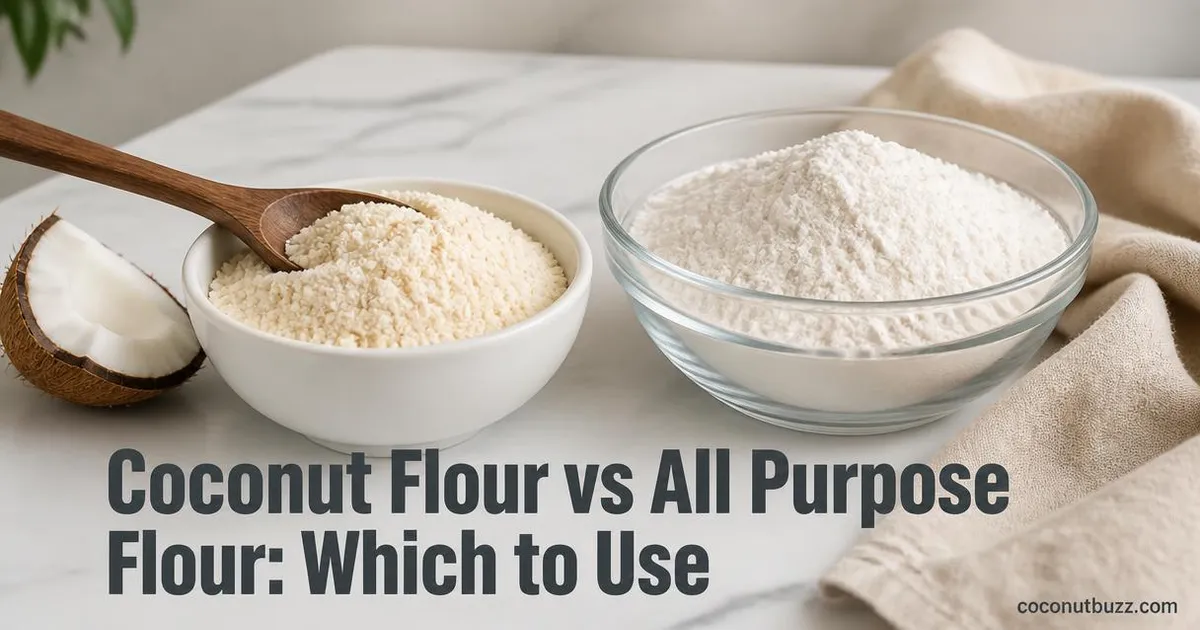
Coconut Flour vs All Purpose Flour: Which to Use
Two flours that look nothing alike and behave completely differently in the kitchen. One is the default in most recipes. The other requires you to relearn some baking basics.
The choice depends on what you’re making, your dietary needs, and whether you’re willing to adjust your technique. Coconut flour and all purpose flour aren’t interchangeable – they’re fundamentally different ingredients that happen to share a name.
Key Takeaways
- Coconut flour absorbs significantly more liquid than all purpose flour, so you can’t swap them at equal amounts without recipe adjustments.
- Coconut flour has fewer net carbs and more fiber than all purpose flour, which is why it’s popular for low-carb and keto diets.
- All purpose flour gives you predictable texture and rise in most baked goods, while coconut flour needs more eggs and liquid to bind properly.
- You’ll typically use only about a quarter to a third of a cup of coconut flour to replace one cup of all purpose flour.
- Coconut flour has a mild flavor that doesn’t necessarily taste like coconut, but it changes the texture of baked goods noticeably.
Related Reading
A clear comparison of coconut cream and coconut milk for cooking and baking that helps readers understand different…
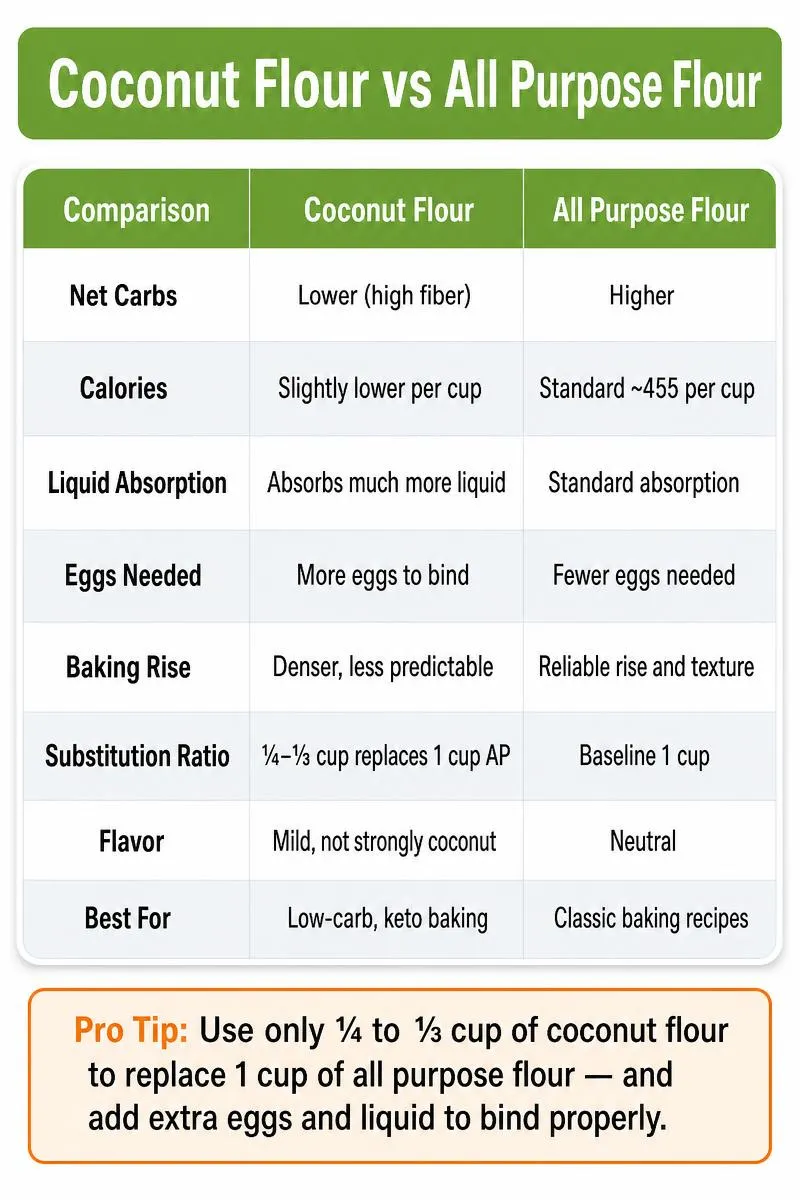
Coconut Flour Vs All Purpose Flour Compared
| Comparison | Coconut Flour | All Purpose Flour |
|---|---|---|
| Net Carbs | Lower (high fiber) | Higher |
| Calories | Slightly lower per cup | Standard ~455 per cup |
| Liquid Absorption | Absorbs much more liquid | Standard absorption |
| Eggs Needed | More eggs to bind | Fewer eggs needed |
| Baking Rise | Denser, less predictable | Reliable rise and texture |
| Substitution Ratio | ¼–⅓ cup replaces 1 cup AP | Baseline 1 cup |
| Flavor | Mild, not strongly coconut | Neutral |
| Best For | Low-carb, keto baking | Classic baking recipes |
What Is Coconut Flour?
Coconut flour comes from dried, ground coconut meat after the oil has been extracted. What’s left is a fine, soft powder that’s naturally gluten-free and grain-free.
Best use cases include low-carb baking, keto recipes, and gluten-free baking when paired with other ingredients. Coconut flour works well in muffins, pancakes, and quick breads where a denser texture is acceptable.
Strengths: Coconut flour has a high fiber content and a lower carb count than wheat flour. The fiber helps retain moisture in baked goods, which can keep them from drying out as quickly.
Weaknesses: Coconut flour is ultra-absorbent, meaning it pulls in liquid far more aggressively than all purpose flour. This requires recipe modifications – more eggs, more liquid, and a completely different approach to ratios. Used incorrectly, coconut flour can produce dense, crumbly, or gummy textures that don’t resemble anything made with wheat flour.
What Is All Purpose Flour?
All purpose flour is milled from wheat, specifically a blend of hard and soft wheat varieties. The result is a flour with a moderate protein content that works across a huge range of recipes.
All purpose flour contains gluten – the proteins glutenin and gliadin – which form an elastic network when mixed with water. That network traps air bubbles during baking and gives bread its structure, cakes their lift, and cookies their chew.
Best use cases span nearly every category: cookies, cakes, bread, pancakes, muffins, pie crusts. All purpose flour works reliably in any standard baking recipe without modification.
Strengths: Versatility and predictability. All purpose flour behaves the same way every time, is available in every grocery store, and has been the backbone of home baking for generations.
Weaknesses: All purpose flour is higher in carbs than coconut flour and contains less fiber. The gluten that makes all purpose flour so useful in baking also makes it unsuitable for anyone with celiac disease or gluten sensitivity.
Coconut Flour vs All Purpose Flour: Carbs and Calories
Coconut flour has significantly fewer net carbs than all purpose flour. The reason comes down to fiber – coconut flour contains a high amount of dietary fiber, which subtracts from the total carb count to give you a lower net carb figure.
All purpose flour, being a refined carbohydrate, has more total carbs and very little fiber. The refining process removes the bran and germ from the wheat, leaving mostly starch.
Per cup, all purpose flour is higher in total calories. But you use much less coconut flour per recipe – often a quarter to a third of the volume – so the per-serving comparison shifts depending on what you’re baking.
If you’re following a low-carb or keto diet, coconut flour is the clear winner. If carbs aren’t a concern for you, all purpose flour works fine and you don’t need to think about net carb math.
Related Reading
A side-by-side look at carbs and blood-sugar effects for sweetener choices that complements the article’s nutrition and…
Coconut Flour vs All Purpose Flour: Baking Behavior
All purpose flour and coconut flour behave so differently in baking that calling them both “flour” can be misleading.
All purpose flour contains glutenin and gliadin, two proteins that form gluten when hydrated and kneaded. Without that gluten network, coconut flour can’t trap air on its own.
Coconut flour absorbs three to four times more liquid than all purpose flour. That means a batter that looks too wet with coconut flour is probably just right – the flour will continue soaking up moisture as it sits.
Because coconut flour lacks gluten, recipes need significantly more eggs to bind ingredients and create structure. Eggs provide the protein network that gluten would otherwise supply. Coconut flour baked goods come out denser and more cake-like, while all purpose flour produces lighter, airier textures.
All purpose flour wins for predictable, consistent baking. Coconut flour works well, but only if you’re following recipes specifically designed for it.
Coconut Flour vs All Purpose Flour: Substitution and Conversion
You cannot substitute coconut flour for all purpose flour at a one-to-one ratio. Doing so will give you a dry, crumbly mess because coconut flour drinks up liquid like a sponge.
The general rule is to use about a quarter to a third of a cup of coconut flour for every one cup of all purpose flour. You also need to add extra eggs and liquid to compensate for how much moisture the coconut flour will absorb.
Even with those adjustments, direct swaps rarely work well. Coconut flour performs best in recipes specifically formulated for it – ones where the egg-to-flour ratio, liquid content, and rising agents have all been calibrated for its absorbency.
All purpose flour, by contrast, can replace most other flours more easily because its behavior is consistent and well understood. If you need a flour that’s simple to swap and forgiving to work with, all purpose flour wins this category easily.
Coconut Flour vs All Purpose Flour: Taste and Texture
Coconut flour has a mild, slightly sweet flavor that doesn’t strongly taste like coconut. The coconut aroma is faint, and in most baked goods it fades behind other ingredients.
All purpose flour has a nearly invisible flavor that lets other ingredients – vanilla, chocolate, fruit – dominate.
Coconut flour tends to make baked goods denser, more moist, and sometimes crumbly depending on the recipe. All purpose flour delivers the texture most people expect from baked goods – light, springy, and structurally sound.
All purpose flour wins if you want a neutral taste and familiar texture. Coconut flour is worth using if you want extra moisture retention and don’t mind a denser result.
Related Reading
Practical guidance on how coconut oil behaves in cooking and baking-useful for readers comparing texture and moisture…
Coconut Flour vs All Purpose Flour: Blood Sugar Impact
Coconut flour’s high fiber content may result in a slower blood sugar response compared to all purpose flour. Fiber slows digestion, which means the carbohydrates in coconut flour enter your bloodstream more gradually.
All purpose flour is a refined carbohydrate that your body breaks down quickly. That faster breakdown can cause a sharper rise in blood sugar after eating.
Some sources suggest coconut flour is a better choice for blood sugar management. For anyone managing blood sugar or following a diabetic-friendly eating approach, coconut flour is the stronger option.
Which Should You Choose?
Choose coconut flour if you’re following a low-carb, keto, or gluten-free diet and are willing to use recipes designed for it. Coconut flour also makes sense if you want to increase your fiber intake and reduce net carbs in baked goods.
Choose all purpose flour if you want reliable results in standard baking recipes without extra trial and error. All purpose flour is also the better pick if you’re new to baking or need a single flour that works across a wide range of recipes.
Coconut flour works well for pancakes, muffins, and quick breads where density is acceptable. Avoid coconut flour for yeasted breads or delicate pastries – it can’t replicate the structure gluten provides.
FAQs About Coconut Flour and All Purpose Flour
How much coconut flour equals one cup of all purpose flour?
Typically, you’d use about a quarter to a third of a cup of coconut flour to replace one cup of all purpose flour. You also need to add extra liquid and eggs – coconut flour absorbs far more moisture than wheat flour, so the rest of the recipe has to compensate.
Can you substitute coconut flour for all purpose flour in any recipe?
No, direct substitution doesn’t work. Coconut flour has no gluten, absorbs several times more liquid, and needs more eggs to create structure. Coconut flour performs best in recipes specifically formulated for it rather than swapped into existing wheat-flour recipes.
Is coconut flour healthier than all purpose flour?
That depends on your dietary goals. Coconut flour has more fiber and fewer net carbs than all purpose flour, which matters if you’re eating low-carb. For general baking where carbs aren’t a concern, all purpose flour is perfectly fine and far easier to use.
What are common mistakes when baking with coconut flour?
The biggest mistakes are not adding enough liquid or eggs, trying to use coconut flour at a one-to-one ratio with wheat flour, and expecting the same texture you’d get from all purpose flour. Coconut flour needs significantly more moisture and binding agents to work properly.
Does coconut flour taste like coconut?
Coconut flour has a mild, slightly sweet flavor but doesn’t taste strongly of coconut in most baked goods. The coconut aroma is faint and usually gets overshadowed by other ingredients like vanilla, chocolate, or spices.
Which flour is better for keto or low-carb diets?
Coconut flour is the clear choice. It has fewer net carbs and more fiber than all purpose flour, which aligns with the goals of keto and low-carb eating.
What’s the best way to store coconut flour?
Store coconut flour in an airtight container in a cool, dry place. Coconut flour contains natural oils from the coconut that can go rancid if exposed to heat or light for extended periods, so the pantry or refrigerator both work well.
Can coconut flour help with blood sugar control?
Possibly. Coconut flour’s high fiber content may slow digestion compared to refined all purpose flour, which could lead to a more gradual blood sugar response. The fiber content makes coconut flour a reasonable choice for anyone managing blood sugar.
Final Verdict
All purpose flour wins for versatility, ease of use, and predictable results. Coconut flour wins for low-carb and gluten-free diets – but only if you’re ready to follow recipes designed for it.
If you’re managing carbs or blood sugar, coconut flour is worth the learning curve. If you want one flour that works in most situations without modifications, stick with all purpose.
Start with one coconut flour recipe that’s specifically written for it rather than trying to convert your favorite all purpose flour recipe. That single step saves you most of the frustration.
External References
- How to Calculate Net Carbs: A Keto Coach’s Complete Guide – Promealplan
- How to Calculate Net Carbs – Healthline
- Glycaemic index of different coconut (Cocos nucifera)-flour … – NIH
- Gluten-Associated Medical Problems – StatPearls – NCBI – NIH – NIH
- The Effects of Soluble Dietary Fibers on Glycemic Response – NIH