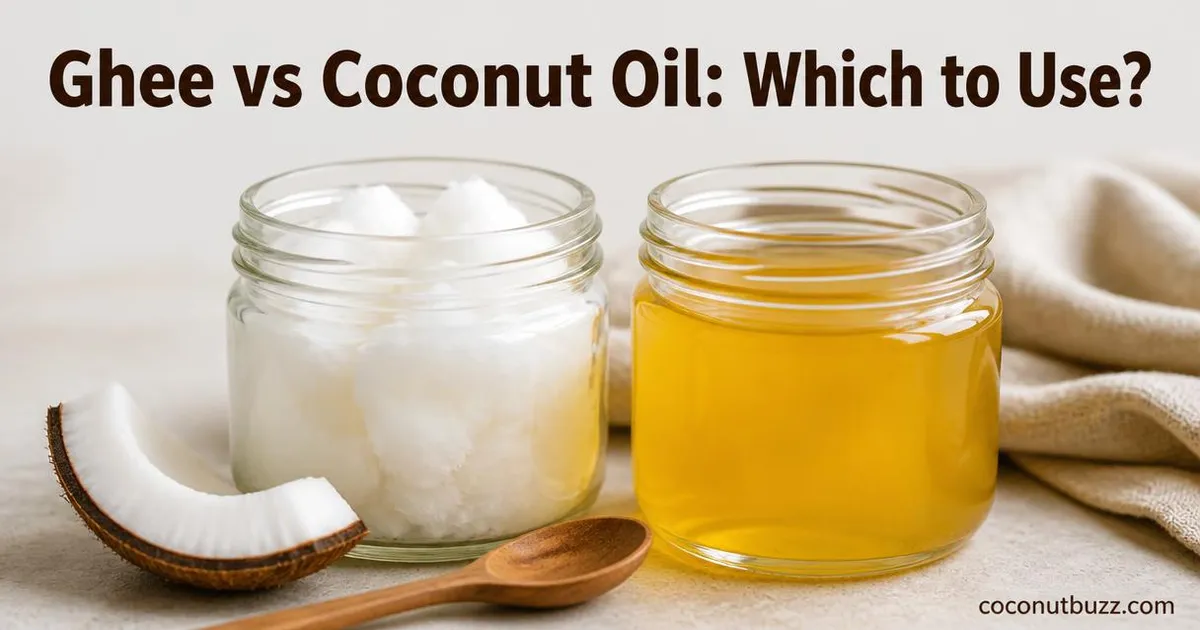
Ghee vs Coconut Oil: Which to Use?
Ghee wins the high-heat contest by a wide margin, but coconut oil delivers more medium-chain triglycerides and works for people who can’t do dairy. Neither one is a shortcut, and both carry the same calorie load per serving.
The choice depends on which cooking you actually do and which dietary restrictions you have. If you’re frying pakoras or tempering dal, ghee behaves better under sustained heat. If you’re vegan or want the most MCTs per serving, coconut oil is the only option that works.
Key Takeaways
- Ghee tolerates higher heat than virgin coconut oil, making it the safer choice for tadka and deep frying.
- Coconut oil delivers more medium-chain triglycerides; ghee contains vitamins A, D, E, and K2 not found in coconut oil.
- Ghee fits savory Indian cooking and baking; coconut oil suits moderate-heat cooking and sweet or neutral dishes.
- Some sources suggest ghee offers butyric acid that may support gut health, though evidence remains early.
- Vegans need coconut oil; anyone avoiding dairy should skip ghee.
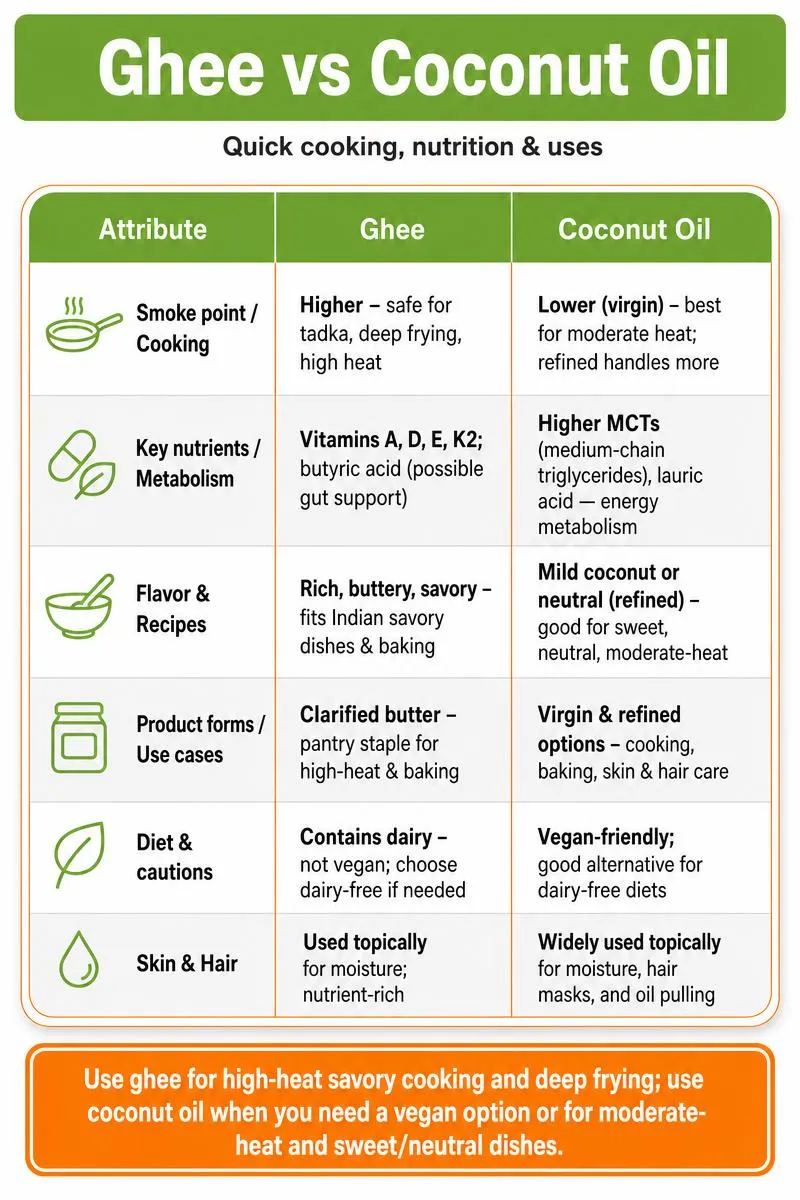
Ghee Vs Coconut Oil Side-by-Side
| Attribute | Ghee | Coconut Oil |
|---|---|---|
| Smoke point / Cooking | Higher — safe for tadka, deep frying, high heat | Lower (virgin) — best for moderate heat; refined handles more |
| Key nutrients / Metabolism | Vitamins A, D, E, K2; butyric acid (possible gut support) | Higher MCTs (lauric acid) — energy metabolism |
| Flavor & Recipes | Rich, buttery — savory, Indian dishes & baking | Mild/neutral — good for sweet, neutral, moderate-heat |
| Product forms / Use cases | Clarified butter — pantry staple for high-heat & baking | Virgin & refined — cooking, baking, skin & hair care |
| Diet & cautions | Contains dairy — not vegan; avoid if dairy-free | Vegan-friendly — good alternative for dairy-free diets |
| Skin & Hair | Topical moisturizer — nutrient-rich | Topical uses — moisture, hair masks, oil pulling |
What Is Ghee?
Ghee is clarified butter with the milk solids and water removed, leaving pure butterfat behind. The process originated in India thousands of years ago as a way to preserve butter without refrigeration. You heat butter slowly, let the milk proteins separate and brown slightly, then strain them out.
The result works best for high-heat frying, Indian tadka, and baking where you want a rich, nutty flavor without the burn risk of whole butter. Ghee stays solid at cool room temperature and liquid when warm, and it keeps for months on the counter because removing the milk solids eliminates the compounds that spoil fastest.
Ghee tolerates sustained high heat, delivers a deep savory flavor, and contains almost no lactose once properly clarified. Traditional grass-fed varieties cost more than standard ghee, and the dairy origin means it’s off-limits for vegans and anyone avoiding animal products entirely.
Explore More
A clear look at coconut milk’s nutrition and culinary uses that readers comparing ghee and coconut oil may want next.
What Is Coconut Oil?
Coconut oil comes from pressing the white meat of mature coconuts, and the type you buy determines how it behaves in your kitchen. Virgin coconut oil keeps the coconut aroma and flavor because it’s pressed from fresh or dried meat without chemical solvents. Refined coconut oil goes through additional processing – often bleaching and deodorizing – that removes most of the coconut taste and raises the smoke point.
Coconut oil works best for moderate-heat cooking, raw use in smoothies or energy balls, and topical applications on skin or hair. The tropical flavor pairs well with curries, baked goods that welcome a hint of coconut, and any dish where you want that distinct aroma.
Coconut oil is fully plant-based, stays solid at room temperature in most climates, and offers flexibility beyond the stovetop. Virgin varieties smoke at lower temperatures than ghee, and the strong coconut flavor clashes with dishes that need a neutral fat – think garlic bread or savory pastry.
Ghee vs Coconut Oil: Smoke Point and Cooking
Ghee smokes somewhere above refined coconut oil and well above virgin coconut oil, making it the safer bet when you’re frying puris, making tadka for dal, or searing protein at high heat. Virgin coconut oil starts breaking down and smoking at moderate temperatures, which limits how aggressively you can cook with it. Refined coconut oil bridges the gap – it tolerates more heat than virgin but still falls short of ghee’s range.
For daily Indian cooking that involves tempering whole spices in hot fat or deep frying snacks, ghee delivers more margin before the oil starts degrading and producing off flavors. Refined coconut oil works as a compromise if you need a plant-based fat that can handle higher heat than virgin varieties.
When you’re reading labels, look for terms like “virgin” or “cold-pressed” on coconut oil – those signal lower smoke points and stronger flavor. Ghee labels sometimes specify grass-fed or cultured, which affect taste and vitamin content but not the smoke point itself. If the jar doesn’t list a smoke point, assume virgin coconut oil maxes out around moderate sautéing heat, refined coconut oil handles most stovetop cooking, and ghee covers everything including sustained high-heat frying.
Ghee vs Coconut Oil: Nutrition and Metabolism
Fatty acid profiles split the difference between these two fats in ways that matter if you’re choosing based on specific nutrients. Coconut oil contains more medium-chain triglycerides – caprylic acid, capric acid, and lauric acid – which your liver can convert directly into energy without the longer digestive process that long-chain fats require. Ghee delivers mostly long-chain saturated and monounsaturated fats, along with vitamins A, D, E, and K2 that coconut oil lacks entirely.
Ghee also contains butyric acid, a short-chain fatty acid that some sources suggest may support gut lining health and reduce inflammation in the digestive tract, though human evidence remains early. Coconut oil wins on MCT concentration, which is why people chasing ketone production or quick energy often prefer it over other fats.
Both fats show up in weight loss discussions, but total calorie intake and overall diet quality matter far more than swapping one fat for another.
Keep Reading
Details on coconut cream’s fat profile and cooking uses, useful when discussing metabolism and nutrition of coconut…
Ghee vs Coconut Oil: Flavor and Recipes
Ghee brings a nutty, caramelized butter flavor that enhances savory dishes without announcing itself the way coconut oil does. It works in traditional Indian recipes – dal tadka, biryani, paratha – and in baking where you want richness without a tropical note. The flavor reads as neutral enough for garlic mashed potatoes, pie crust, or anything that would traditionally use butter.
Coconut oil adds a distinct aroma you cannot miss. The virgin version adds a distinct coconut aroma that works beautifully in Thai curries, tropical baked goods, granola, and desserts where that flavor belongs. It clashes with dishes that need a clean backdrop – tomato sauce, roasted vegetables, or French toast all taste off when coconut competes with the main ingredients.
When the coconut flavor is welcome, virgin oil delivers both function and taste. When it’s not, refined coconut oil or ghee becomes the better choice. Some people love the tropical note in everything; others find it intrusive after the first few uses.
Ghee vs Coconut Oil: Skin and Hair Care
Both fats absorb into skin and hair, but they behave differently once applied. Coconut oil penetrates the hair shaft more effectively than most oils because its molecular structure allows it to slip past the outer cuticle and reduce protein loss from washing and heat styling. It also works as an occlusive moisturizer on skin, meaning it sits on the surface and slows water evaporation rather than hydrating from within.
Ghee contains fat-soluble vitamins that may support skin repair and hydration when applied topically, and traditional Ayurvedic practice uses it for dry skin, minor burns, and chapped lips. The texture is richer than coconut oil, and it melts at body temperature, which makes it easy to massage into skin or scalp.
Coconut oil favors people with thick or coarse hair that benefits from deep conditioning, and it works well for those with oily or combination skin who want a lightweight occlusive layer. Ghee suits people with very dry skin or hair, or anyone looking for a richer emollient that delivers vitamins A and E topically. If you have acne-prone skin, coconut oil clogs pores for some people and ghee may do the same – patch-test before committing to either one.
Which Should You Choose?
You fry or do tadka daily – ghee handles the heat without breaking down or producing off flavors at high temperatures.
You follow a vegan or dairy-free diet – coconut oil is the only option that fits your restrictions, and refined versions work for higher-heat cooking.
You want the highest MCT intake – coconut oil delivers more medium-chain triglycerides per serving than ghee or most other cooking fats.
You need a neutral fat for savory Indian cooking and baking – ghee provides richness without the coconut aroma that clashes with garlic, onion, and spice-forward dishes.
You want one fat for both cooking and skin care – coconut oil works for both if you have normal-to-oily skin and thick hair; ghee works better if your skin runs very dry and you want topical vitamins.
Also Worth Checking Out
Coconut yogurt vs greek yogurt
A dairy-vs-coconut comparison that complements the ghee (dairy) vs coconut oil (plant) decision context for readers…
FAQs About Ghee and Coconut Oil
Can I replace coconut oil with ghee in recipes?
Yes, in most cooked applications. The swap works best in savory dishes and baking where you don’t want coconut flavor. Raw recipes like energy balls or smoothies will taste different because ghee is solid at room temperature and carries a buttery note instead of tropical sweetness.
Is ghee healthier than coconut oil?
Neither one is universally healthier – ghee offers vitamins A, D, E, and K2 plus butyric acid, while coconut oil delivers more medium-chain triglycerides. Your choice depends on whether you prioritize fat-soluble vitamins or MCTs, and whether you avoid dairy.
Which is better for high-heat Indian cooking, ghee or coconut oil?
Ghee. It tolerates sustained high heat better than virgin coconut oil and won’t break down during tadka, deep frying, or high-temperature roasting. Refined coconut oil works as a plant-based alternative but still falls slightly short of ghee’s smoke point.
Does coconut oil have more MCTs than ghee?
Yes. Coconut oil contains a much higher concentration of medium-chain triglycerides – primarily lauric acid, caprylic acid, and capric acid – while ghee consists mostly of long-chain saturated and monounsaturated fats with minimal MCT content.
Is ghee or coconut oil better for weight loss?
Neither one causes weight loss on its own. Coconut oil’s MCTs may increase energy expenditure slightly compared to long-chain fats, but the effect is small and doesn’t outweigh total calorie intake. Both fats deliver the same calorie load per serving, so portion size matters more than which one you choose.
Which is better for skin and hair, ghee or coconut oil?
Coconut oil penetrates hair shafts more effectively and works well for deep conditioning thick or coarse hair. Ghee provides a richer emollient for very dry skin and delivers fat-soluble vitamins topically. People with acne-prone skin should patch-test both, as either can clog pores.
Can I use ghee and coconut oil together?
Yes. Some people blend them to balance the high smoke point of ghee with the MCT content of coconut oil, or to moderate the coconut flavor while keeping the fat plant-based in part. The mix works in cooking and baking where you want traits from both fats.
Is coconut oil or ghee better for diabetics?
Neither fat raises blood sugar directly, but total calorie and carbohydrate intake matter more than which fat you cook with. Some early research suggests MCTs in coconut oil may improve insulin sensitivity slightly, while ghee’s butyric acid may support gut health, but neither effect is large enough to guide diabetes management on its own.
Which should vegans choose, ghee or coconut oil?
Coconut oil. Ghee is dairy-derived and not vegan. If you need a high-heat plant-based fat, refined coconut oil, avocado oil, or refined peanut oil all work better than virgin coconut oil.
Why do cardiologists say to avoid coconut oil?
Coconut oil is high in saturated fat, which some studies link to elevated LDL cholesterol in certain people. Current guidelines from many cardiology organizations recommend limiting saturated fat from all sources, though the evidence on coconut oil specifically remains mixed. If you have high cholesterol or cardiovascular risk factors, ask your doctor which fats fit your situation.
Final Thoughts
Ghee is the more practical cooking fat for high-heat applications and savory food that needs a neutral or buttery backdrop. Coconut oil is the plant-based option with higher medium-chain triglycerides and more versatility for skin and hair care.
Refined coconut oil works for higher heat than virgin varieties, and budget labels vary widely in quality and smoke point – read the fine print before assuming all ghee or all coconut oil behaves the same. Test a small amount of each in your own tadka and baking to see which flavor and behavior you prefer.
External References