3 Types of Coconuts and How to Tell Them Apart
Walk into a grocery store and you’ll see green coconuts, brown coconuts, and sometimes smaller ones labeled ‘young’ or ‘fresh.’ Then you hear growers talk about tall palms and dwarf palms. So what actually counts as a type of coconut?
Three palm types exist: tall, dwarf, and hybrid. Within those, fruit color, shape, and size vary quite a bit. Every coconut you’ll ever eat comes from one palm species, Cocos nucifera. The types are really varieties and cultivars bred from that single species.
Key Takeaways
- Coconuts fall into three palm types: tall, dwarf, and hybrid.
- Tall palms are the most abundant coconut plant worldwide, so most coconuts in commerce come from this type.
- Dwarf palms are the small coconut trees people ask about when they want something manageable.
- Hybrid palms combine tall and dwarf traits and are often bred for disease resistance.
- Fruit color, shape, and size vary within each type, so color alone does not identify a variety.
- Coconut palms need warm, humid conditions, which limits where each type can grow.
Related Reading
Green coconut vs brown coconut
A focused comparison of young (green) and mature (brown) coconuts that helps readers identify the types described in…
Types Of Coconuts Compared
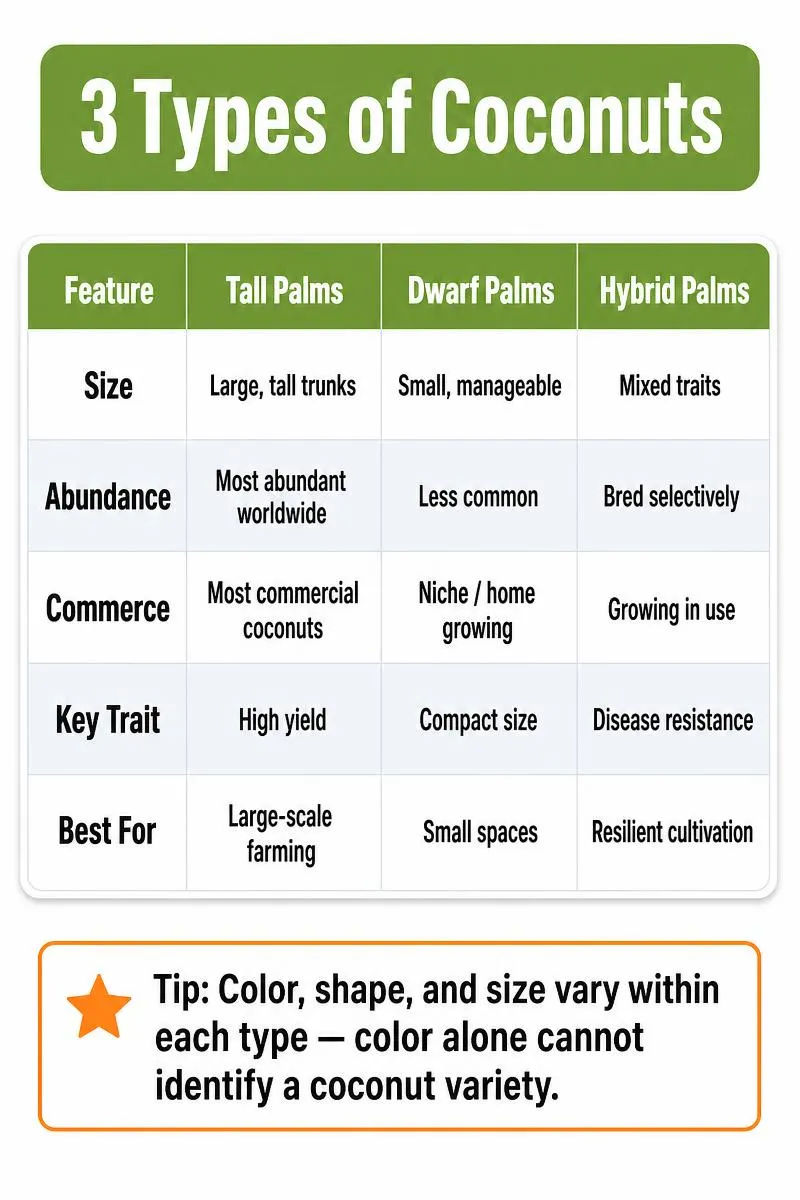
| Feature | Tall Palms | Dwarf Palms | Hybrid Palms |
|---|---|---|---|
| Size | Large, tall trunks | Small, manageable | Mixed traits |
| Abundance | Most abundant worldwide | Less common | Bred selectively |
| Commerce | Most commercial | Niche/home growing | Increasing use |
| Key Trait | High yield | Compact size | Disease resistance |
| Best For | Large-scale farming | Small spaces | Resilient cultivation |
3 Types of Coconuts
Growers sort them by stature, growth habits, and breeding history.
1. Tall Coconut Palms
Tall coconut palms are the classic, most abundant type. Botanists group most of them under the name Typica, which covers the widespread varieties planted across the tropics. If you’re tracing where commercial coconut supply comes from, tall palms are the backbone.
These palms begin fruiting at five to eight years after planting. A tall palm can live close to 100 years and stays productive for roughly 50 of those years. Fruit color can be green, depending on the variety, though tall palms also produce brown, yellow, and orange fruit.
2. Dwarf Coconut Palms
Dwarf coconut palms are the second major type. What separates dwarfs from tall palms is stature: dwarf palms stay much shorter, making them easier to harvest and manage on smaller land.
Dwarf palms also tend to come into production earlier than tall palms. The tradeoff is a shorter productive lifespan and generally smaller fruit yields per palm. If you’re comparing planting options and want a small coconut tree, dwarfs are the type to look at first.
3. Hybrid Coconut Palms
Hybrid coconut palms are crosses of tall and dwarf parents. Breeders create hybrids to combine the early fruiting and manageable size of dwarf palms with the yield and vigor of tall palms.
A key reason breeders pursue hybrids is disease resistance. In Florida, cultivar work has focused on resistance to lethal yellowing disease, a phytoplasma infection that has devastated coconut palms across the Caribbean and parts of the southern US. Hybrid cultivars bred from resistant dwarf and tall parents offer growers a way to keep palms standing in areas where lethal yellowing is active.
If you’re growing coconuts in a region with disease pressure, hybrids are the type worth examining closest.
Where Coconut Palms Grow
Coconut palms need warm temperatures and high relative humidity to thrive. The ideal growing conditions sit within tropical latitudes. Altitude matters too: coconut palms generally grow best at low elevations where temperatures stay consistently warm.
Coconut palms also tolerate salt in the soil and coastal air, which is why you see them thriving along shorelines. That salt tolerance lets them grow in sandy coastal soils where most fruit trees cannot survive.
In the US, these requirements limit coconut growing to the warmest regions. Florida leads the way, with small plantings also possible in parts of Hawaii and southern Texas. Most of the continental US simply gets too cold.
Some growers use monoculture plantations with spaced rows, while others intercrop coconut palms with other tropical plants like bananas or cacao.
Keep Reading
Explains how coconut palms differ from other palm species and where to spot them-useful after the ‘Where Coconut Palms…
How Coconut Palms Grow and Fruit
Coconut palms start from the fruit itself. A mature coconut contains a seed that germinates when conditions are warm and moist. The shoot emerges from one of the three eyes on the coconut’s surface, and roots develop from the same point. Growers propagate new palms by planting whole mature coconuts in nursery beds or directly in the ground.
Flowering begins once the palm reaches maturity. Tall palms typically start flowering at five to eight years, while dwarf palms can start earlier. The palm produces both male and female flowers on the same inflorescence, a branched spike that emerges from the leaf axils. Pollination can happen by wind or insects, and fertilized female flowers develop into coconuts over a growing period that varies by climate and variety.
A mature palm produces fruit continuously through the year in tropical climates, with new inflorescences opening at regular intervals. Over the palm’s long lifespan, the trunk grows from a single growing point at the top, adding height steadily. Tall palms reach considerable heights, while dwarfs stay significantly shorter. Production peaks during the middle years and tapers as the palm ages.
FAQs About Coconuts
What is the difference between white and brown coconuts?
Color reflects maturity and variety, not type. Young coconuts have white or green husks and contain more coconut water. As the fruit matures, the husk turns brown and the coconut develops thicker, firmer meat.
Do coconuts grow in Vietnam?
Yes. Vietnam has active coconut cultivation, particularly in the Mekong Delta region, where the climate provides the warmth and humidity coconut palms need.
What is the rarest type of coconut?
Some fruit forms are rare, such as coconuts with unusual color or shape in limited cultivars. Macapuno, where the coconut meat fills most of the cavity instead of producing normal meat and water, is one well-known rare form.
What is a small coconut tree?
Dwarf coconut palms. These stay much shorter than tall palms and are what people usually mean when they ask about small coconut trees.
How many years does it take to grow a coconut tree?
Tall palms take five to eight years to begin fruiting after planting. Dwarf palms can come into production sooner.
Which trees look like coconut palms?
Several palm species resemble coconut palms, including royal palms, queen palms, and foxtail palms. None of these produce coconuts – only Cocos nucifera does.
Which US states grow coconuts?
Florida is the leading state for coconut palm cultivation. Hawaii also supports coconut growth, and small plantings may survive in protected spots in southern Texas.
What is the common name of a coconut tree?
Coconut palm. That’s the everyday name for Cocos nucifera.
Why don’t all palm trees grow coconuts?
Only one palm species bears coconuts. The palms you see in landscaping or wild settings may be date palms, royal palms, queen palms, or dozens of other species that produce different fruit or no edible fruit at all.
You Might Also Like
Practical guidance on which coconut oil types come from different coconut stages and which are best for cooking and use.
Final Thoughts
All three types, tall, dwarf, and hybrid, are varieties of one palm species. Your choice comes down to climate, space, and what you want from the tree. Before planting or shopping, match your local growing conditions to the type that fits.
External References
- UF/IFAS scientist reaches turning point on palm disease … – Ufl
- High Amounts of Saturated Fats Increased Heart Disease … – Healthmanagement
- Coconut water: Is it super hydrating? – Mayo Clinic
- PP-222/PP146: Lethal Yellowing (LY) of Palm – Ask IFAS – Ufl
- Coconut Oil and Heart Health: Fact or Fiction? – Researchgate
- Coconut Water: A Sports Drink Alternative? – PMC – NIH